

Impressum (Site Notice)
Information provided according to Sec. 5 German Telemedia Act (TMG)
Tenzin Peljor
(Michael Jäckel)
Florastraße 20
13187 Berlin
Contact
Tel: 0176 996 527 29
Email: tenzin@gmx.org
Web: www.tenzinpeljor.de | www.michaeljäckel.de
Editorial cooperation
Monika Deimann-Clemens
VAT
VAT Id number according to Sec. 27 a German Value Added Tax Act: DE
Dispute resolution
The European Commission provides a platform for online dispute resolution (OS): https://ec.europa.eu/consumers/odr.
Please find our email in the impressum/legal notice.
Liability for Contents
As service providers, we are liable for own contents of these websites according to Sec. 7, paragraph 1 German Telemedia Act (TMG). However, according to Sec. 8 to 10 German Telemedia Act (TMG), service providers are not obligated to permanently monitor submitted or stored information or to search for evidences that indicate illegal activities.
Legal obligations to removing information or to blocking the use of information remain unchallenged. In this case, liability is only possible at the time of knowledge about a specific violation of law. Illegal contents will be removed immediately at the time we get knowledge of them.
Liability for Links
Our offer includes links to external third party websites. We have no influence on the contents of those websites, therefore we cannot guarantee for those contents. Providers or administrators of linked websites are always responsible for their own contents.
The linked websites had been checked for possible violations of law at the time of the establishment of the link. Illegal contents were not detected at the time of the linking. A permanent monitoring of the contents of linked websites cannot be imposed without reasonable indications that there has been a violation of law. Illegal links will be removed immediately at the time we get knowledge of them.
Copyright
Contents and compilations published on these websites by the providers are subject to German copyright laws. Reproduction, editing, distribution as well as the use of any kind outside the scope of the copyright law require a written permission of the author or originator. Downloads and copies of these websites are permitted for private use only.
The commercial use of our contents without permission of the originator is prohibited.
Copyright laws of third parties are respected as long as the contents on these websites do not originate from the provider. Contributions of third parties on this site are indicated as such. However, if you notice any violations of copyright law, please inform us. Such contents will be removed immediately.
Quelle: https://www.e-recht24.de

Theravada (Pali) Buddhism
Tibetan Buddhism
- Buddhism In a Nutshell: The Four Seals of Dharma by Dzongsar Jamyang Khyentse Rinpoche
- The Berzin Archives by Dr. Alexander Berzin
- 84.000
Q&A by www.info-buddhism.com
- Q&A “Shugden protests” with Robert Barnett
- Q&A “Shugden conflict” with Thierry Dodin
- Q&A “Self-Immolations” with Thierry Dodin
- Q&A “Controversies related to Tibetan Buddhism, the Dalai Lamas and Tibet” with Thierry Dodin uncompleted)
Food for Thought
No matter whether they are something positive or negative, it is of great importance to get to the bottom of the true facts.
Not only previously, in the past, but today also there are people who love Tibet and for whom all of Tibet is something entirely positive. This is not in accordance with the truth (Dalai Lama laughs). On the other hand, there are people who want to show that Tibet had negative sides, and they make all of Tibet into something negative. Both views are of course distorted.
I am convinced, and tell my friends and listeners again and again, that the true meaning of education is to lessen the gap between reality and perception. This is what both science and Buddhist philosophy seek to do. HH the 14th Dalai Lama in a speech about Dreamworld Tibet—Western Illusions by Martin Brauen.
We Tibetans are aware of some Western followers who believe that Tibetan lamas are enlightened buddhas and infallible gurus, despite their all-too-human deficiencies. It is disillusioned Westerners, who in the course of their lives have experienced the total collapse of their ideals, and who cling to the wishful image of a holy and healing Tibetan tradition. Wherever angst, insecurity, and despair are strong, there is a corresponding desire for something superior, and Westerners project fatherly power upon the lamas. A false understanding of Buddhist teachings, especially that of the Vajrayana, has impelled these projections.
The myth of Tibet and the Western crisis of the senses thus work together to make a quick, but rather superficial, spread of Tibetan Buddhism possible. Tibetan Buddhism, however, has quite a bit more to offer than exotic symbolism and mystical sensations. It is a path that one must take seriously: Clear instructions and a disciplined, systematic practice are its foundation.
…
Although one can assume that most exiled lamas show a sincere interest in preserving and spreading their religious culture, their integrity and credibility are still endangered when they try to play the "great wise ones." This makes their work easier—at least at first—and people can easily approach them. With time, however, an unhealthy and ultimately unavoidable dynamic is set in motion. In contrast, the Dalai Lama exemplifies the positive approach with his personal and ideological credibility, especially insofar as he refuses to project certain images.
Historically speaking, one could claim that the Tibetan people idealized and even worshiped lamas. But the Dalai Lama is trying to oppose just such religious and social degeneration with his reforms. Pious Tibetans often listened to a lama teach publicly for days—without understanding a word. They were satisfied with the blessings his presence afforded and practiced Buddhism according to their own level of understanding. Such people were devoted indeed, but also naive and superstitious. Such is unacceptable for long-term growth among Tibetans, much less Westerners. It is my opinion that a progressive, critical investigation of the myth of Tibet and its effects is necessary in order to prevent harmful developments of this sort. After thirty years, we can now see that the positive aspects of the traditional image of Tibet have had rather negative consequences for the long-term propagation of Buddhism, while the negative aspects of this image, at the very least, have stimulated Tibetan lamas and their students to evaluate themselves critically and, in the end, fruitfully.HE Dagyab Kyabgön Rinpoche »Buddhism in the West and the Image of Tibet« in Imagining Tibet - Perceptions, Projections, and Fantasies, Boston: Wisdom Publications, 2001, pp. 386-388.
In Tibet as in many a country, in addition to genuine religious teachers there were also a host of dubious mendicants, madmen, and charlatans who plied their trade among the faithful, and life within the big monasteries witnessed the full range of human personalities, from saintly to coldly calculating.Prof. Dr. David Jackson in »Apropos a Recent Tibetan Art Catalogue«, Wiener Zeitschrift für die Kunde Südasiens, Vol. 37, 1993: 110.
Dharma Quotes
A wise person will have faith in the teachings of all orders, will love the Dharma found in each just as a mother cherishes all her children. A wise person's mind is vast like the sky, with room for many teachings, many insights, many meditations. But the mind of an ignorant sectarian is limited, tight, and narrow like a vase that can only hold so much. It is difficult for such a mind to grow in Dharma because of its self-imposed limitations. The difference between the wise Buddhist and the sectarian Buddhist is like that between the vastness of space and the narrowness of a vase.Jamgön Kongtrul Lodro Thaye
And from this day on in every life, with the special motivation that holds others dearer than self, bless me to protect the Buddha's teaching like my life, as you Mahatma, have done.
And you in whose heart or pure appearance there is no sectarian prejudice please clear away the trouble to the Buddha's teaching raised by the specter of sectarianism in those who become partisan when they hold you as supreme.The final two verses of Taktsang Lotsawa's Biography of Tsongkhapa, Sarnath 1967, p. 619)
Just as a king overpowered by self-interest Is not worthy of being the protector of the kingdom, A sectarian person is not worthy of being a holder of the dharma. Not only that, he is unworthy of upholding even his own tradition.Jamgön Kongtrul Lodro Thaye
The noble ones share a single ultimate view, but arrogant ones bend that to their own interests. Those who show all the teachings of the Buddha as without contradiction can be considered learned people. But who would be foolish enough to think that those who cause discord are holders of the dharma?Jamgön Kongtrul Lodro Thaye
The scholars and siddhas of the various schools make their own individual presentations of the dharma. Each one is full of strong points and supported by valid reasoning. If you are well grounded in the presentations of your own tradition, then it is unnecessary to be sectarian. But if you get mixed up about the various tenets and the terminology, then you lack even a foothold in your own tradition. You try to use someone else's system to support your understanding, and then get all tangled up, like a bad weaver, concerning the view, meditation, conduct, and result. Unless you have certainty in your own system, you cannot use reasoning to support your scriptures, and you cannot challenge the assertions of others. You become a laughing stock in the eyes of the learned ones. It would be much better to possess a clear understanding of your own tradition.
In summary, one must see all the teachings as without contradiction, and consider all the scriptures as instructions. This will cause the root of sectarianism and prejudice to dry up, and give you a firm foundation in the Buddhas teachings. At that point, hundreds of doors to the eighty-four thousand teachings of the dharma will simultaneously be open to you.Jamgön Kongtrul Lodro Thaye
According to Ringu Tulku Rinpoche:
Shakyamuni Buddha forbade his students to criticize others, even the teachings and teachers of other religions and cultures. This directive was so strong and unambiguous that in the Introduction to the Middle Way, Chandrakirti felt compelled to defend Nagarjunas Madhyamaka treatises by saying:
If, in trying to understand the truth, one dispels misunderstandings, and therefore some philosophies cannot remain intact, that should not be considered as criticizing others' views.

Dharma Quotes from: The Ri-Me Philosophy of Jamgön Kongtrul the Great: A Study of the Buddhist Lineages of Tibet by Ringu Tulku, ISBN 1-59030-286-9, Shambhala Publications & Golden Garland of Eloquence, Vol. 1 - Tsong Kha Pa, translated by Gareth Sparham, Jain Publishing.
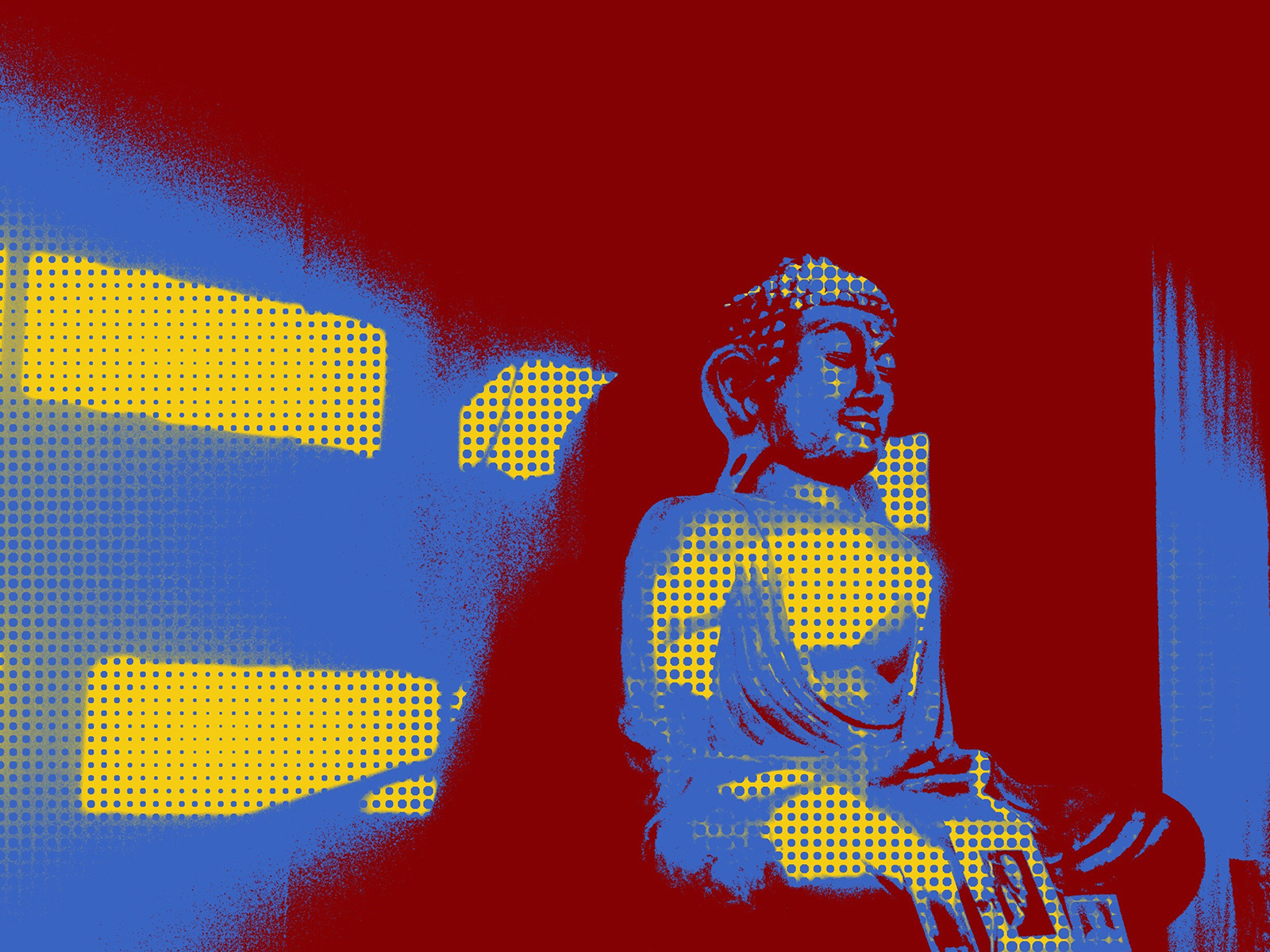
Header image: © TP. Buddha statue, Bodhicharya Berlin, 2014.