
From Protective Deities to International Stardom: An Analysis of the Fourteenth Dalai Lama’s Stance towards Modernity and Buddhism
Georges B. Dreyfus
Department of Religions
Williams College
- The Dalai Lamas – About
- The Dalai Lama in Global Perspective
- 5th Dalai Lama, Ngawang Lobsang Gyatso — About
- 5th Dalai Lama, Ngawang Lobsang Gyatso — Opinion on His Rule
- 13th Dalai Lama, Thubten Gyatso – About
- 13th Dalai Lama, Thubten Gyatso – Opinion on His Rule
- 14th Dalai Lama – About
- 14th Dalai Lama – His Accomplishments
- HHDL
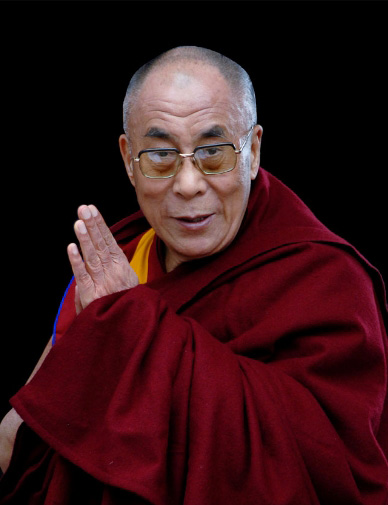
The XIVth Dalai Lama, Tenzin Gyatso.
© www.dalailama.com - printable4_fs
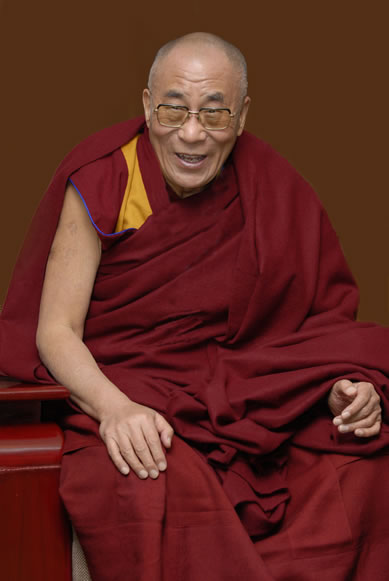
The XIVth Dalai Lama, Tenzin Gyatso.
© www.dalailama.com - printable1_fs
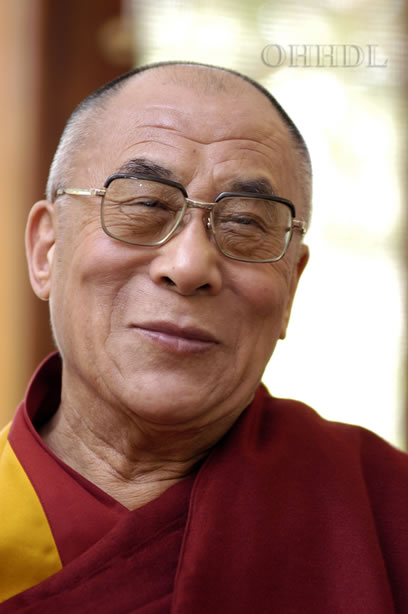
The XIVth Dalai Lama, Tenzin Gyatso.
© www.dalailama.com - printable9_fs
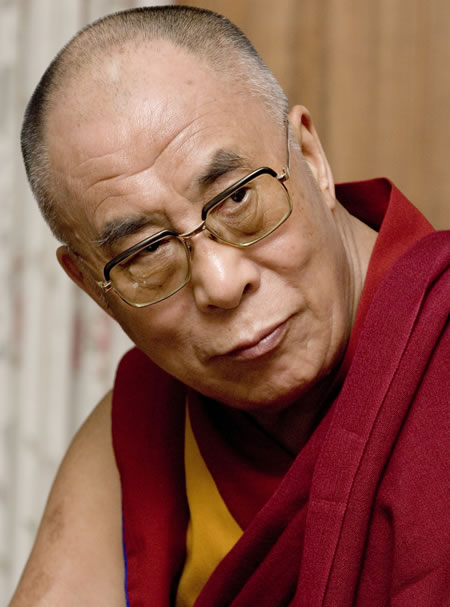
The XIVth Dalai Lama, Tenzin Gyatso.
© www.dalailama.com - printable6_fs
The XIVth Dalai Lama, Tenzin Gyatso.
© Tenzin Jamphel / OHHDL. Details: Official Dalai Lama Facebook Site - printable8_fs
The XIVth Dalai Lama, Tenzin Gyatso.
© www.dalailama.com - printable7_fs
The XIVth Dalai Lama, Tenzin Gyatso.
© www.dalailama.com
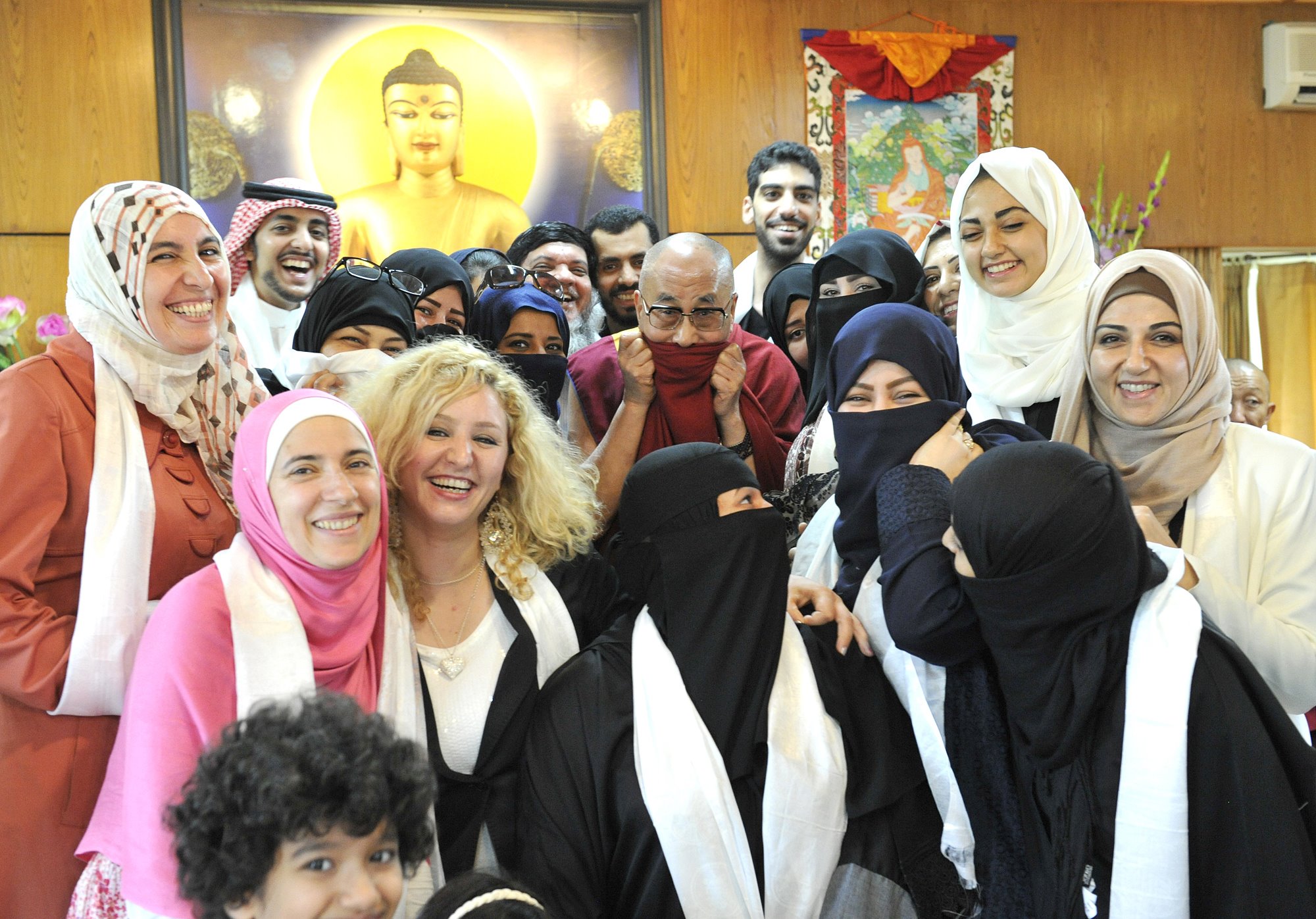

The Dalai Lamas
“The Dalai Lamas are held by their followers to be advanced Mahayana bodhisattvas that is compassionate beings who so to speak have postponed their own entry into nirvana to help suffering humanity. Thus they are thought to be well on the way to Buddhahood, developing perfection in wisdom and compassion for the benefit of all sentient beings. It is this that justifies doctrinally the socio-political involvement of the Dalai Lamas, as an expression of a bodhisattva’s compassionate wish to help others.”
“We should note here two things a Dalai Lama is not. First, he is not in any simple sense a ‘god-king’. He may be a sort of king, but he is not for Buddhism a god. Second, the Dalai Lama is not the ‘head of Tibetan Buddhism’, let alone of Buddhism as a whole. There are many traditions of Buddhism. Some have nominated ‘Heads’; some do not. Within Tibet too there are a number of traditions. The Head of the Geluk tradtion is whoever is abbot of Ganden monastery, in succession to Tsong kha pa, the fourteenth/fifteenth century Geluk founder.”
Paul Williams, “Dalai Lama”, in Clarke, P. B., Encyclopedia of New Religious Movements, (New York: Routledge, 2006), p. 136.
The Dalai Lama in Global Perspective
“Westerners who study the system of reincarnating lamas are often understandably skeptical about it, but it seems clear that somehow the Tibetans who choose the Dalai Lamas have managed to find a remarkable succession of unusually gifted people. Even given the profound devotion that Tibetans feel for their Dalai Lamas, it would be difficult to disguise an incarnation who was stupid, arrogant, greedy, or belligerent. Those Dalai Lamas who attained maturity, however, have consistently distinguished themselves in their teaching, writing, and their personal examples. The present Dalai Lama is a testament to the success of the system through which Dalai Lamas are found, and it is improbable that his remarkable Accomplishments are merely due to good training. Many monks follow the same basic training as the Dalai Lamas, but somehow the Dalai Lamas tend to rise above others of their generation in terms of scholarship, personal meditative attainments, and teaching abilities. It is true that they receive the best training, and they also have the finest teachers, but these facts alone fail to account for their accomplishments. In Western countries, many students enroll in the finest colleges, study with the best teachers, and still fail to rise above mediocrity because they are lacking in intellectual gifts.”
“There are obviously problems with the system, particularly the problem of lapses of leadership while newly recognized Dalai Lamas reach maturity. The system worked well enough in the past when Tibet was not beset by hostile neighbors, but it is difficult to imagine any country in the present age being able to endure periods of eighteen years or more without a true leader. It is not surprising, therefore, that the present Dalai Lama has expressed doubts about the continuing viability of the institution of the Dalai Lamas and has indicated that he may not choose to reincarnate. He has also proposed that the office of Dalai Lama become an elected position, with the Tibetan people voting for their spiritual leader. The Dalai Lama appears to recognize the flaws in the present system and apparently hopes that the institution will be adapted to changing times.”
John Powers, “Introduction to Tibetan Buddhism”, Snow Lion Publications, 1995, pp. 186–87.
The Fifth Dalai Lama, Ngawang Lobsang Gyatso (1617–1682)
“The 5th Dalai Lama, known to Tibetan history simply as the ‘Great Fifth,’ is renowned as the leader under whom Tibet was unified in 1642 in the wake of bitter civil war. The era of the 5th Dalai Lama—roughly the period from his enthronement as leader of Tibet in 1642 to the dawn of the 18th century, when his government began to lose control—was the formative moment in the creation of a Tibetan national identity, an identity centered in large part upon the Dalai Lama, the Potala Palace of the Dalai Lamas, and the holy temples of Lhasa. During this era the Dalai Lama was transformed from an ordinary incarnation among the many associated with particular Buddhist schools into the protector of the country. In 1646 one writer could say that, due to the good works of the 5th Dalai Lama, the whole of Tibet was now centered under a white parasol of benevolent protection. And in 1698 another writer could say that the Dalai Lama’s government serves Tibet just as a bodhisattva—that saintly hero of Mahayana Buddhism—serves all of humanity.”
Kurtis R. Schaeffer, “The Fifth Dalai Lama Ngawang Lopsang Gyatso”, in The Dalai Lamas: A Visual History, Serinda Publications, Edited by Martin Brauen, 2005, p. 65.
The Fifth Dalai Lama: Opinion on His Rule
“By most accounts the [5th] Dalai Lama was by the standards of his age a reasonably tolerant and benevolent ruler.”
Paul Williams, “Dalai Lama”, in (Clarke, 2006, p. 136).
“The fifth Dalai Lama, Ngawang Losang Gyatso (1617–1682), popularly referred to as ‘The Great Fifth,’ was the most dynamic and influential of the early Dalai Lamas. He was a great teacher, an accomplished tantric yogin, and a prodigious writer. His literary output surpasses the combined total of all the other Dalai Lamas. In addition to his scholastic achievements, he proved to be an able statesman, and he united the three provinces of Tibet (the Central, South, and West) for the first time since the assassination of king Lang Darma in the mid-ninth century.”
“Although he was rather heavy-handed with the Jonangpas and the Karmapas, his treatment of other orders was often generous. He was particularly supportive of Nyingma, and he himself was an ardent practitioner of several Nyingma tantric lineages. Snellgrove and Richardson contend that on the whole his actions proved to be beneficial and stabilizing, despite the obvious hard feelings they engendered among his opponents:
‘The older orders may preserve some bitter memories of the fifth Dalai Lama, for no one likes a diminution of wealth and power, but there is no doubt that without his moderating and controlling hand, their lot might have been very much worse. It must also be said that at that time, despite their new political interests and responsibilities, the dGe-lugs-pas remained the freshest and most zealous of the Tibetan religious orders.’” (Snellgrove & Richardson, A Cultural History of Tibet, p. 197)
(Powers 1995: 145,146–47)
More about the Fifth Dalai Lama
- “The Fifth Dalai Lama and his Reunification of Tibet” by Samten G. Karmay
- “The Great Fifth” by Samten G. Karmay
The Thirteenth Dalai Lama, Thubten Gyatso (1876–1933)
“The other Dalai Lama who was particularly important was the Thirteenth (1876–1933). A strong ruler he tried, generally unsuccessfully, to modernize Tibet. The ‘Great Thirteenth’ also took advantage of weakening Chinese influence in the wake of the 1911 imperial collapse to reassert de facto what Tibetans have always considered to be truly the case, the complete independence of Tibet as a nation from China.”
Paul Williams, “Dalai Lama” in (Clarke, 2006, p. 137).
“Some may ask how the Dalai Lama’s rule compared with that of rulers in European or American countries. But such a comparison would not be fair, unless applied to the Europe of several hundred years ago, when it was still in the same stage of feudal development that Tibet is in at the present day. Certain it is that Tibetans would not be happy if they were governed as people are in England; and it is probable that they are on the whole happier than are people in Europe or America under their own governments. Great changes will come in time; but unless they come slowly, when the people are ready to assimilate them, they will cause great unhappiness. Meanwhile, the general administration in Tibet is more orderly than the administration in China; the Tibetan standard of living is higher than the standard in China or India; and the status of women in Tibet is higher than their status in either of those two large countries.”
Sir Charles Bell, “Portrait of a Dalai Lama: The Life and Times of the Great Thirteenth”, Wisdom Publications, 1987, pp. 443–444.
The Thirteenth Dalai Lama: Opinion on His Rule
“Was the Dalai Lama on the whole a good ruler? We may safely say that he was, on the spiritual as well as the secular side. As for the former, he had studied the complicated structure of Tibetan Buddhism with exceptional energy when a boy, and had become exceptionally learned in it. He improved the standard of the monks, made them keep up their studies, checked greed, laziness and bribery among them, and diminished their interference in politics. He took care of the innumerable religious buildings as far as possible. On the whole it must certainly be said that he increased the spirituality of Tibetan Buddhism.
“On the secular side he improved law and order, increased his own contact with his people, introduced more merciful standards into the administration of justice and, as stated above, lessened monastic domination in secular affairs. In the hope of preventing Chinese invasions he built up an army in the face of opposition from the monasteries; prior to his rule there was practically no army at all. In view of the extreme stringency of Tibetan finance, the intense monastic opposition and other difficulties, he could have gone no farther than he did.
“During his reign the Dalai Lama abolished Chinese domination entirely throughout the large part of Tibet governed by him, excluding Chinese officials and soldiers. That portion of Tibet became a completely independent kingdom, and remained independent during the last twenty years of his life.”
Sir Charles Bell in (Bell 1987: 444).
More about the Thirteenth Dalai Lama
- “The Thirteenth Dalai Lama, Tubten Gyatso” by Tsering Shakya
The Fourteenth Dalai Lama, Tenzin Gyatso
“The current Fourteenth Dalai Lama (Tenzin Gyatso) was born in 1935. The Chinese invaded Tibet in the early 1950s and the Dalai Lama left Tibet in 1959. He now lives as a refugee in Dharamsala, North India, where he presides over the Tibetan Government in Exile. A learned and charismatic figure, he has been active in promoting the cause of his country’s independence from China. He also promulgates Buddhism, world peace, and research into Buddhism and science, through his frequent travels, teaching, and books. Advocating ‘universal responsibility and a good heart’, he was awarded the Nobel Peace Prize in 1989.”
Paul Williams, “Dalai Lama”, in (Clarke, 2006, p. 137).
Biography
The Fourteenth Dalai Lama: His Accomplishments
“When one considers the origins of the present Dalai Lama, his successes are remarkable. Born in a remote village in eastern Tibet, driven from his country by an invading army and forced to start over in exile, he is today a Nobel Prize laureate and one of the world’s most revered religious leaders. When one considers the odds against randomly choosing a young child from a remote Tibetan village, educating him in a traditional Tibetan monastic curriculum, and his later winning the Nobel Peace Prize, his successes might give skeptics pause. As Glenn Mullin remarks of the fourteenth Dalai Lama,
‘the depth of his learning, wisdom and profound insight into the nature of human existence has won him hundreds of thousands of friends around the world. His humor, warmth and compassionate energy stand as living evidence of the strength and efficacy of Tibetan Buddhism, and of its value to human society.’” (Mullin, Glenn, Selected Works of the Dalai Lama II, 1982, p. 220)
(Powers 1995: 187)
In recent years, the 14th Dalai Lama has acquired the stature of international star. His travels are media events, his lectures are sold out, and his books almost invariably land on the bestseller list. For many, he has acquired an iconic status, representing what is most authentic and valuable in the Buddhist tradition, a source of inspiration and moral guidance. This admiration is widely shared not just among Tibetans but also among the educated public of the industrial world. From France to Taiwan to the United States, many see him as an embodiment of Buddhist compassion.
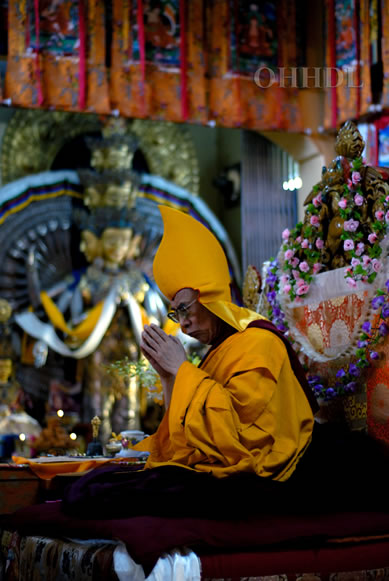
Why are people so taken now by the Dalai Lama, who had previously been ignored or considered an oddity? This question is all the more intriguing when one considers that in the West the Dalai Lama rarely displays his enormous learning and considerable intellectual acumen, instead mostly offering plain exhortations about being compassionate and tolerant. Normally such exhortations would leave most people cold, but when spoken by the Dalai Lama, they win enthusiastic audience response. Why this enthusiasm? A first answer is that there is more to communication than mere words, and the experience of seeing a person who has devoted himself to the well-being of his people and hence whose life is to a large extent in agreement with his words is itself a great source of inspiration. When the Dalai Lama exhorts his hearers to be compassionate, they respond not only to the content of his words but also, indeed mostly, to their recognition of his very real compassion, intelligence, charisma, and communicative skills. However, this answer is not sufficient, as his fame also depends in part on peoples’ perceptions of him and the ideals he has come to represent. What are these ideals? And are the views of his audiences appropriate, or are they groundless projections shaped by orientalist expectations?
This essay addresses these questions by examining some of the ideas with which the Dalai Lama is associated, particularly among Westerners who see him as embodying the fundamental principles of Buddhism. I will argue that these ideas are part of what many have called Buddhist modernism, a modern reconfiguration of the tradition rather than the expression of its timeless essence. I will also argue that this description of the Dalai Lama as a Buddhist modernist only partly corresponds to his own views and practices. My investigation will be focused on the recent controversy that has surrounded a previously obscure deity, Dorje Shukden (rdo rje shugs ldan). I will argue that the Dalai Lama’s actions in this controversy show that in many ways he is a traditionalist Buddhist master whose ideas and practices are quite different from the irenic version of Buddhism that many associate with him. I will conclude by reflecting on the complexities and tensions created by the coexistence of these two seemingly conflicting frameworks in a single person.
The Dalai Lama as a Buddhist Modernist
Buddhist modernism refers to an understanding of Buddhism developed first in the Buddhist (mostly Theravada) world at the end of the 19th century as a reaction to Western domination.¹ Buddhist modernism sought to respond to the colonial negative portrayal of Buddhism by presenting the tradition in modern and positive terms. The modernist perspective came to depict Buddhism as a world religion on par with the other world religions, particularly christianity, as far as having its own founder, sacred scriptures, philosophical tradition, and so on. Moreover, in this view Buddhism is in many ways superior to the other religions, because it is based on reason and experience and does not presuppose any blind acceptance of authority. Buddhist practice is held to be a highly rational endeavor that is fully compatible with modern science, whose authority it claims. Buddhism is even at times presented as an empirical inner science whose findings are waiting to be discovered by the modern West. As a religion, if it can be so called, Buddhism is said not to be interested in dogmas and institutions but merely to provide its followers a path leading to the overcoming of suffering. This perspective considers Buddhism to be strongly ethical, devoted to nonviolence, and providing valuable resources for social action. Its recommended practice is said to be meditation, while ritual is devalued as popular superstition or adaptations to the demands of the laity.²
This greatly simplified description characterizes quite well the belief system of many contemporary Buddhists, particularly in the West, where many have come to regard Buddhism as more a philosophy than a religion, a spirituality consonant with the scientific spirit of inquiry rather than a faith based on the acceptance of dogmas. The Dalai Lama expresses this view of Buddhism when he says:
Suppose that something is definitively proven through scientific investigation. That a certain hypothesis is verified and that a certain fact emerges as a result of scientific investigation. And suppose, furthermore, that that fact is incompatible with Buddhist theory. There is no doubt that we must accept the result of scientific research. You see, the general Buddhist position is that we must accept fact. Mere speculation devoid of an empirical basis, when such is possible, will not do. We must always accept the fact. So if an hypothesis has been tested and has been found to be one hundred percent sure, then it is a fact and that is what we must accept.³
In addition to viewing Buddhism as based on empirical investigation and in agreement with the contemporary scientific spirit, many in the modern world consider it expressive of the freedom of personal inquiry, considering its essence to be the tolerance, compassion, and wisdom gained through that inquiry. For modernists, these qualities are the true essence of the tradition. Everything else is the result of deformations created by historical contingencies and local cultures.
Many have argued, however, that this view of Buddhism is a rather selective reinterpretation of the tradition, which in fact contains much more than that. This is not to say that the modernist view lacks ample basis in the tradition. The canon is full of exhortations for monks and nuns to practice diligently and to rely on themselves rather than on external salvation. But it should be clear that this view of Buddhism leaves out more than it includes. In particular, in overlooking rituals, mythology, and metaphysics, it omits central aspects of the tradition that are grounded in well-established canonical material and have played foundational roles in all the historically known Buddhist traditions. Thus, far from corresponding to the essence of the tradition, the contemporary perspective is an innovation inspired by modern ideas about religion and philosophy, ideas that are often inspired by the Protestant view of religion as a matter of individual belief and commitment rather than communal practice.
Some scholars have argued that many of the Dalai Lama’s ideas about Buddhism correspond to Buddhist modernism and that his success is in large measure a function of his ability to embody the virtues associated with that stance. One of them, Donald Lopez, has described the Dalai Lama as “the leading proponent of Buddhist modernism.”⁴ Those highlighting the Dalai Lama’s modernist orientation have cited his Ghandhian advocacy of nonviolence, his participation in interfaith dialogues, and his strong interest in encounters with scientists. The Dalai Lama has also said that the essence of the tradition consists of virtues such as wisdom and compassion, which he contrasts with the more superficial trappings of culture. For example, he says:
When we speak of the essence [of a religious tradition], there is no question about suitability and no need to change the basic doctrines. However, on the superficial level change is possible. A Burmese monk in the Theravada tradition whom I met recently in Europe and for whom I developed great respect makes the distinction between cultural heritage and the religion itself. I call this a distinction between the essence of a religion and the superficial ceremonial and ritual level.⁵
In making this fundamental distinction between the essence of Buddhism and its cultural expressions, the Dalai Lama seems to agree with Buddhist modernism, as the distinction allows for adapting the tradition to the new circumstances of modernity while claiming to preserve its integrity.
This flexibility has enabled him to connect with great success to modern audiences, especially in the international arena, for his ideas correspond to his audiences’ needs and fit their worldviews. This may seem surprising, since most people who come to hear the Dalai Lama expect to meet an extraordinary personality expressing the views of a different and even exotic tradition. But what they hear is often surprisingly familiar to them, and this odd mixture of the familiar and the foreign has a profound influence on the outcome of the encounter.
This is especially the case with the Dalai Lama’s distinction between superficial ritual and the essence of Buddhism. As noted above, this idea appeals to the modern audience because it corresponds to the individualized conception of religion that has come to be widely accepted in the modern West. When expressed by a personality with such obvious authority and respectibility as the Dalai Lama, this idea acquires for his listeners a new legitimacy, being seen as a deep and eternal truth rather than an expression of the views of the time. Few in the Dalai Lama’s audience realize that what they are hearing is a reflection of modern developments in Buddhism rather than the traditional Buddhist conceptions.
For most of its history, however, Buddhism has encouraged a very different attitude, for example, reserving the actual practice of meditation mostly for monastic elites and arguing that in an age of degeneration such as ours it is very meritorious just to practice ritual or to hold Buddhist views. Hence, when the Dalai Lama distinguishes the essence of the tradition from rituals, and when he exhorts his followers to engage in personal religious meditative practice and not to worry too much about traditional orthodoxy, he is not so much following an age-old tradition as innovating, adapting Buddhist ideas to a modern context by advocating lay adoption of prescriptions traditionally reserved for elite practitioners.
The Dalai Lama as Traditionalist
Yet the description of the Dalai Lama as a Buddhist modernist does not fully capture the Dalai Lama’s thought. Though he certainly believes in some of the tenets of Buddhist modernism, and though he also uses the modernist idiom as a way to help his audience understand Buddhism, in accordance with the classical doctrine of skillful means, there is much more to the Dalai Lama’s ideas and practices than Buddhist modernism. Overattention to the “modernist” label would obscure the complexity of his positions and the way his ideas have evolved. Some of this complexity is revealed by his stance on the controversy surrounding the Dorje Shukden deity.
The Dorje Shukden dispute concerns the propitiation of a protective deity, Shukden, a practice that the Dalai Lama has come to condemn in an increasingly vocal manner.⁶ Shukden’s followers claim that the practice dates back to a rather obscure and bloody episode of Tibetan history, the violent death of Drakpa Gyaltsen (grags pa rgyal mtshan) (1618-1655), an important Geluk lama and a rival of the 5th Dalai Lama (1617-1682). Because of his premature death, Drakpa Gyaltsen is said to have been transformed into a wrathful spirit bent on the protection of the doctrinal purity of the Geluk tradition. He is also said to be particularly irked at those Geluk lamas, such the 5th Dalai Lama, who study and practice the teachings of other traditions, and he is said to have contributed to the deaths of several of them.
However, it is only during the early part of the 20th century that this systematic connection between Shukden and Drakpa Gyaltsen was clearly established. Prior to this date Shukden seems to have been a worldly god with a relatively limited following. The linkage between Shukden and the Geluk tradition was mostly the work of Pabongka (1878-1941), a charismatic teacher who spearheaded a revival movement within the Geluk tradition, partly in reaction to the success of the nonsectarian revival among the other schools. Connecting Shukden to Drakpa Gyaltsen seems to have been a way for Pabongka to left his adoption of this originally non-Geluk deity as the main protector of his movement. The elevation of Shukden’s status was one of three key elements in Pabongka’s new understanding of the Geluk tradition: Vajrayoginl was upheld as the main meditational deity, Shukden as the protector, and Pabongka or his successors as the guru. Pabongka’s vision was strongly exclusivist: not only was the Geluk tradition considered supreme, but its followers were warned of dire consequences if they showed interest in other traditions. Shukden would deal harshly with them, it was said, just as he had with several earlier eclectic Geluk lamas who had died prematurely at his hands.
In recent decades the Dalai Lama has opposed this understanding of the deity in increasingly vigorous ways, going so far as to ban its followers from some of his teachings. The reasons for his opposition are complex. In part he is concerned about the sectarian orientation that accompanies the Shukden tradition. He is also personally committed to a rival protective deity named Nechung (gnas chung) and to the accompaying ritual system underlying the institution of the Dalai Lamas. The latter institution rests on an elaborate and eclectic ritual system that has close ties with various schools of Tibetan Buddhism. It has particularly close ties with the Nyingma school, the one most closely associated with the early empire and its mythological figures and gods. This link with the Nyingma School is particularly visible in the roles given to Padmasambhava, one of the foundational figures of Tibetan Buddhism, and Nechung, an early Tibetan god who is said to be in charge of protecting the Dalai Lama and his government. The propitiation of Shukden undermines this eclectic system and its close links with the Nyingma School. In particular, by presenting Shukden as an exclusivist deity in charge of visiting retribution upon those in the Geluk order who have adopted practices from other traditions, the cult of Shukden threatens the Dalai Lama’s reliance on Padmasambhava and Nechung and hence the integrity of the entire ritual system underlying the institution of the Dalai Lamas, at least as conceived by its present incumbent. This threat is captured by the opposition between Shukden and Nechung. Shukden is said to undermine Nechung, who resents Shukden’s role and actions. Nechung is therefore seen to be prodding the Dalai Lama to act against Shukden by urging people to abandon the propitiation of this deity and even acting directly to ban the practice. The Dalai Lama himself has described on numerous occasions the strength of his relation to Nechung and the role of this deity in his decisions concerning Shukden.⁷
An interesting facet of the Shukden affair has been its illustration of the Dalai Lama’s reliance on divination and other traditional means to decide important issues. This appears in the Dalai Lama’s description of the way he decided to abandon shukden, whose practice he himself had taken on at an early age.⁸ The Dalai Lama says that, after long considerations, he decided to submit the question to his other important protector, the Great Goddess Palden Lhamo ('pal Idan lha mo), the Tibetan equivalent of Mahadevi. Should he continue publicly the practice of Shukden, he asked, should he do it only secretly, or should he stop altogether? Each of these alternatives was written on a piece of paper, each of which was put in a separate small ball of dough. All three balls were then put in a cup on the altar of the Great Goddess. After propitiating the deity for a long time in the company of several ritual specialists, the Dalai Lama took the cup and rolled the balls around in it until one of them came out. The answer it contained decided the issue: the Dalai Lama would abandon Shukden completely. This decision has had enormous consequences. It has changed his personal practice and the ritual system of the Dalai Lama institution, and has also prompted him to become increasingly vocal in his opposition to Shukden.
The Dalai Lama’s use of divination may surprise those who think of Buddhism as a rational philosophy shunning rituals. But for most Asian Buddhists, ritual is an essential element of the tradition and adherents make no excuse for its importance. The Dalai Lama is no exception. He has been open about his reliance on this form of divination and his general commitment to the rituals of protectors. In an unpublished interview, the Dalai Lama expressed to me his complete confidence in the value of this practice, one he has used at several key junctures of his life, lefting it with the phrase: “I am a Buddhist after all, am I not?”⁹ This statement speaks volumes for the Dalai Lama’s own understanding of his tradition, an understanding in which protective deities, rituals of propitiation, and modes of divination are self-evidently valid. For him, it is obvious that being a Buddhist implies that one believes in protective deities, follows their rituals, and relies on them for important decisions in life.
Who is the “Real” Dalai Lama?
The traditionalist Tibetan Buddhism of the Dalai Lama’s personal practice seems quite different from the modernism underlying his distinction between “the essence of a religion and the superficial ceremonial and ritual level.”¹⁰ One could be forgiven for asking: who is the real Dalai Lama? Is he the traditionalist who believes in protective deities or the modernist who engages in dialogue with scientists?
The answer is that the Dalai Lama is both. In his personal practice, he is a traditionalist. Every day he does a brief ritual for his main protective deity, the Great Goddess, without whose protection he would not undertake any important task. Even travel must be placed under her auspices, and in all his journeys the Dalai Lama carries with him a painted scroll of this deity. In addition, the Dalai Lama has monks from his monastery Namgyal Dratsang (rnam rgyal gwra tshang) come to his residence to perform the appropriate daily and monthly rituals for all the relevant protective deities. The Dalai Lama considers all these rituals foundational to the Dalai Lama institution and essential to his personal practice. At the same time, in his public work he is a modernist who extols the practice of meditation, urges his Western audiences to go to the essence of the tradition (instead of being caught in the cultural trappings of Tibetan Buddhism), and engages in ongoing dialogues with scientists that include discussion of empirical findings. On the international scene he is, in addition, an inspired speaker who argues for the rationality of compassionate actions and the irrationality of armed conflicts.
The coexistence of such disparate belief systems in a single person may seem surprising, but recognition of this complexity is important for understanding who the Dalai Lama truly is. Clearly, depictions of the Dalai Lama as a Buddhist modernist fail to capture a large part of his actual practice and thinking. In contrast to figures like Dharmapala and Buddhadasa, the Dalai Lama is not, for the most part, a reformist of his own tradition, which he tends to uphold firmly but without rigidity. It is primarily in his dealings with the West that the Dalai Lama acts as a Buddhist modernist, using that idiom to express to this audience some of the Buddhist ideas that he strongly believes. He has also acted as a modernist in some of his advocacy within the Tibetan community, for example promoting democratic ideas and practices as being in accordance with Buddhist ideals.
The Dalai Lama’s modernism is not just an act for Western audiences. For him, wisdom and compassion truly are the essence of the tradition. It is also true, however, that for him the protectors, divinations, and traditional rituals are also important. He sees no contradiction between the traditional and the modern, for the two orientations operate at different levels and are relevant to different contexts. The orientation that deals with the ultimate goals of Buddhism is traditionally considered a higher level of practice reserved for elite practitioners, but it also resonates with modern expectations about religion. The other orientation is equally important, but is reserved for traditional contexts and relates to more immediate concerns. Thus it is that the Dalai Lama’s addresses to Western audiences can reflect his perceptions of their needs, while his personal practice can be guided by other considerations. There is no inherent contradiction in this.
But the lack of a logical contradiction does not mean a lack of tension, and the scope of what the Dalai Lama thinks he can share with his Western audiences has shifted over the years. Again, this can be illustrated by reference to the Shukden affair, where in the early years of the quarrel the Dalai Lama restricted his remarks to Tibetan audiences. In the late 1970s, when I first learned about this quarrel, the Tibetan monks I spoke with were surprised by my ignorance of it. Yet at the time very few Westerners were even aware that the split existed. Only gradually, as devotion to Shukden was slowly spreading among Westerners, did the Dalai Lama begin speaking of it to Western audiences, and even then he did not immediately express the full extent of his opposition. Only after the Dalai Lama had banned Shukden followers from his teachings, and only after the 1997 murder of three monks in apparent response to this ban, did he begin expressing his views on Shukden more fully to Western audiences. His new openness was greeted with puzzlement. I was sitting in such an audience near New York a few years ago when the Dalai Lama started to explain his views and policies regarding this deity. I remember the reaction of malaise among the members of the audience, who were puzzled and made uneasy by this confrontation with an aspect of Tibetan Buddhism that they did not understand. “Why should we be concerned by this?” they seemed to be saying.
This reaction shows the degree to which the two aspects of the Dalai Lama’s thinking had formerly been distinct, as the Dalai Lama had usually kept from his Western audience those ideas and practices that he felt would not be understood. But this separation has not been rigidly maintained. When the Dalai Lama estimates that the stakes are too high or that the time is right for putting things more clearly, the separation breaks down, regardless of the audience’s discomfort. At this point the extent to which the Dalai Lama is not a Buddhist modernist becomes clear, and the audience often reacts with great discomfort.
The Dalai Lama’s modernism also has deep roots, and clearly is important him. Thus, it is more than just a display for Western audiences. Though he understands his primary task to be one of winning not just converts to Buddhism but sympathizers to the Tibetan cause, and though he has shaped his presentation accordingly, he has also been influenced by his contacts with modern institutions. He was initially educated in a traditional Buddhist way, mostly following the curriculum of the great Geluk monastic universities. The Dalai Lama would later remark that this education was unbalanced and inappropriate for a person who was to assume a leadership role.¹¹ He was therefore completely unprepared when the modern world came crashing in on him in 1950, and he coped by trying to learn on the job how to deal with the modern world.
As he did so, he encountered several important sources of influence. One of them came from his dealings with the Chinese. Particularly important in this regard was his trip to China in 1954-55. His encounter with Chairman Mao on that occasion made a lasting impression, as did his visits to Chinese factories. More important, however, may have been his encounters in India, which he visited extensively in 1956 before settling more permanently in 1959 (see page 189). There the Dalai Lama encountered people he could identify with, including not only Prime Minister Nehru but also other lesser-known figures such as Jayaprakash Narayan, Acharya Tulsi, and President Rajendra Prasad. Through their own Hindu or Jain modernism, these people modeled how to be religious while also participating fully in the modern world. Their modernism influenced the Dalai Lama greatly as he developed the outlook and style that have marked his relations with the West.
The Dalai Lama’s modernism has also led him to take fairly radical positions within the Tibetan community. On the political level, he has insisted that the community in exile adopt, despite the misgivings of most of its members, a constitution in which the Dalai Lama’s role is limited and submitted to democratic oversight. The Dalai Lama has also consistently supported the spread of modern education among both lay and monastic Tibetan communities, often against the vigorous opposition of more conservative elements. On the religious level, he has voiced, often sarcastically, his distrust of the institution of reincarnated lamas. I remember hearing him say in the early 1970s that many reincarnated lamas seem great when they are young but disappoint when they grow older: “It is like the teeth of children. They are so cute and yet they rot when they age.” On the other hand, the Dalai Lama has never embraced the modernist distrust of ritual, and in many respects he remains deeply imbued with traditional Tibetan attitudes.
The Dalai Lama’s orientations have changed in subtle but important ways over the years, though their evolution has not been noticed by most observers. Living in Dharamsala in the 1970s and 1980s, I was able to observe some of these changes firsthand. At the beginning of the 1970s I was struck by the Dalai Lama’s refreshingly unconventional ideas, particularly his willingness to relativize and even put to the side certain aspects of his tradition. For example, once when I asked about the practice of the lam rim (lam rim) “Stages of the Path,” he replied, in essence, “Leave it out. It is just what is in the book, not what you actually need to do.” However, sometime in the 1970s he seems to have become more traditional. The turning point appears to have been the winter of 1975-76, when the Dalai Lama was undergoing an important retreat. The Dalai Lama has never fully explained what happened at that retreat, yet from that date onward he began expressing publicly his opposition to Shukden and evidenced a more traditional approach to Buddhist practice. Also, he almost completely dropped his unwillingness to recognize reincarnated lamas, and his formerly biting remarks were replaced by more conventional admonitions.
This return to a more traditionalist attitude, which perhaps could have been expected, did not entail a repudiation of Buddhist modernism. Indeed, modernism remained his favored way of interacting with the West, which he started to visit seriously only at the end of the 1970s, when he was already well over forty. Nevertheless, his traditionalist turn made him more committed to practices such as the propitiation of protectors, particularly those protecting the Dalai Lama institution. This in turn led to the confrontation with the followers of Shukden, which has threatened to split the Geluk tradition. His change in attitude has also had consequences for the Tibetan community in exile, particularly for its Buddhist institutions, where some of the promises of Buddhist modernism have yet to materialize.
In sum, to describe the Dalai Lama simply as a Buddhist modernist is to ignore the important role that traditionalist practices and ideas play in his life. It is also to simplify greatly the views of this complex figure. Very real tensions exist between his traditionalist and modernist stances, and the balance among those stances has changed over time. To international audiences he continues, in modernist fashion, to emphasize the core notions at the heart of Buddhism, and he does not expect his Western disciples to take on the full array of Tibetan customary practice. At the same time, he personally practices the full array of Tibetan Buddhist ritual, and continues to uphold the concepts underlying the institution of the Dalai Lama. Inhabiting these two very different aspects allows him to fulfill his main mission, that of promoting the Tibetan cause and leading the Tibetan people. His modernism allows him to function as an internationally recognized spiritual leader at ease within the various contexts of modernity, whereas his commitment to practices such as that of protectors puts him in touch with the more traditional aspects of the religious culture of his people. However useful this inhabitation may be, it is also not without its difficulties, as we have seen in this essay. Moreover, there is the nagging question of the future of such a stance. Will a future Dalai Lama be able to conciliate so brillantly the conflicting demands of tradition and modernity? This question is inherent to the Dalai Lama institution and the mode of selection on which it is based. But this question acquires a particular urgency in the modern context where the very existence of Tibet seems to be at stake.
Notes
¹ This term was coined by H. Bechert in his “Buddhist Revival in East and West,” in H. Bechert and R. Gombrich, The World of Buddhism (London: Thames and Hudson, 1984), pp. 275-6.
² This brief account of Buddhist modernism draws from Lopez’ summary in Prisoners of Shangrila (Chicago: University of Chicago, 1998), 185, as well as H. Bechert, “Buddhist Revival in East and West,” in H. Bechert and R. Gombrich, The World of Buddhism (London: Thames and Hudson, 1984), pp. 275-6.
³ The Dalai Lama, Answers: Discussions with Western Buddhists (Ithaca: Snow Lion, 2001), p. 24.
⁴ D. Lopez, Prisoners of Shangrila (Chicago: University of Chicago, 1998), p. 185.
⁵ The Dalai Lama, A Policy of Kindness (Ithaca: Snow Lion, 1990), p. 85
⁶ For a detailed account of this controversy, see G. Dreyfus, “The Shuk-den Affair: History and Nature of a Quarrel,” Journal of International Association of Buddhist Studies vol. 21, n. 2 1999): pp. 227-270.
⁷ See the Dalai Lama’s collected speeches from 1978 to 1996 on the subject: Gong sa skyabs mgon chen po mchog nas chos skyong bsten phyogs skor btsal ba'i bka' slob (Dharamsala: Religious Affairs, 1996)., pp. 17-9.
⁸ Sa skyabs mgon chen po mchog nas chos skyong bsten phyogs skor btsal ba'i bka' slob, pp. 36-41.
⁹ Interview with the Dalai Lama, October, 2000.
¹⁰ The Dalai Lama, A Policy of Kindness, p.85.
¹¹ The Dalai Lama, Freedom in Exile (New York: Harper, 1990), p. 25