
A quick note on Dorje Shugden (rDo rje shugs ldan)
Paul Williams
Centre for Buddhist Studies
University of Bristol
The following note is taken from an informal
letter in response to a request for some further information on the
current dispute over Dorje Shugden.¹
Dorje Shugden is a Dharma protector deity, and you can read one of the very few academic accounts of him in English in René de Nebesky-Wojkowitz’s Oracles and Demons of Tibet. Dorje Shugden—at least as it concerns the present dispute—is associated primarily with the Gelug tradition of Tibetan Buddhism, although there have been some adherents from within the Sakya school. I would think the figure of four million adherents which has been mentioned to be very much overexagerrated, and I am not sure how that calculation has been made.
The present dispute over the status of Dorje Shugden between the Dalai Lama and the Shugden Supporters Community / New Kadampa Tradition has its roots in history, and there is a significant dimension of political power involved in the dispute. It is not a simple one of the suppression of religious freedom, as it has been portrayed. I know of no cases in the whole history of Tibetan Buddhism where a tradition or practice has been suppressed on the basis of purely religious factors, and one could not imagine the Dalai Lama—who has always been astonishingly broadminded in matters of religion—having any interest in doing such a thing.
Basically it seems to me that what we are dealing with here is a controversy between Traditionalists and Modernisers. Like all Dharma Protectors Dorje Shugden is a fierce figure who unusually however appears in the form of a Gelugpa monk. He is considered by some of his followers to be an emanation of Manjushri, although others (including I think the New Kadampa Tradition) appear to consider him to be a fully enlightened Buddha of whom Manjushri is himself an emanation. The Dalai Lama, on the other hand, considers Dorje Shugden to be simply a worldly deity—a figure of great power but no intrinsic spirituality—of doubtful reliability and not a Buddha at all, or even a bodhisattva. Thus as regards the doctrinal dispute, for one side it is a matter of relying on a Buddha, albeit an apparently rather fierce Buddha; for the other if they take refuge in a worldly deity then this is to abandon taking refuge solely in the Buddha and thus to abandon the very definition of being a Buddhist. From such a perspective if one is not careful this could easily degenerate into a Buddhist version of demon-worship.
The practice of Dorje Shugden goes back to the I7th Century, but it has been particularly predominant in the 20th Century among followers of the controversial Gelug lama Pabongkhapa, who died in 1941. It is from this lineage tradition, via Pabongkhapa’s principal disciple and the Dalai Lama’s Junior Tutor Trijang Rinpoche, that Geshe Kelsang Gyatso and the NKT trace their connection with Dorje Shugden.
The problem is that Pabongkhapa was renowned for being—or at least held by followers of other schools of Tibetan Buddhism as being—extremely sectarian and intolerant of other schools. The practice of Dorje Shugden was considered at least by other traditions as having been developed as a form of Gelug triumphalism and aimed at bringing into play a Dharma protector for the (magical) suppression of the other schools, or at least their marginalisation. In particular it was considered that the practice of Dorje Shugden was aimed at the Nyingma pa tradition. In the later 1970s and early 1980s there was fierce controversy among certain Gelug, Sakya and Nyingma Lamas in India over Dorje Shugden and his status, which the Dalai Lama attempted to cool down. The material has been published and is available in Tibetan.
The Dalai Lama himself was apparently urged by Trijang Rinpoche to undertake the practice of Dorje Shugden and eventually declined. For some time His Holiness has been sensitive to the problems with this practice in promoting a perceived sectarianism, and he had urged that the practice be undertaken only in private and not promulgated. He also said that those who would take himself as a spiritual master and respect him, and those who work for the Tibetan Government in Exile, should not engage in the practice of Dorje Shugden. This means also that those who would take Tantric initiations from him should not engage in the practice either. If a Tantric master gives initiation to those who take refuge in a worldly god and therefore do not have a pure Buddhist refuge then this can rebound on the health and life of the Tantric master. I suspect this is the primary point behind the Dalai Lama’s reported claim that engaging in the practice of Dorje Shugden might shorten his life. It looks as though what has happened is that recently he has started to put this opposition to the practice of Dorje Shugden forward with greater urgency, perhaps in connection with his attempts to encourage a democratic political system for the Tibetans within which the old sectarian and regional rivalries and antagonisms could have no place.
It is this issue which is far and away the main issue in the controversy between the Dalai Lama and the New Kadampa Tradition, which has been running for some years. It is surprising that there are followers of the NKT who seem to be unaware of the dispute, but it has been marked for some time by the absence of any pictures of the Dalai Lama in NKT centres. One can indeed understand the perspective of Geshe Kelsang Gyatso et al., who hold that the practice of Dorje Shugden is a traditional Gelug practice which they have been taught by their teachers, and their teachers before them. The Dalai Lama as both a political and a spiritual figure considers that this practice is not skilful or suitable for the present situation of the Tibetan people or Tibetan Buddhism in the world. So as I said above, what we have here is clearly a version of the common religious controversy between Traditionalists (I avoid the word ‘Fundamentalists’, which has also been used in this context) and Modernisers. From the perspective of the NKT the Dalai Lama and his followers have abandoned and abused a Buddha (or bodhisattva) and a crucial dimension of the Gelug tradition. Thus the NKT wants to claim at least de facto that they now represent the true Gelug tradition. The so-called ‘Gelug’ tradition at least inasmuch as it is manifest in the Dalai Lama no longer represents the authentic tradition. The NKT does. Hence the importance of Geshe Kelsang Gyatso (and his many books), and the direct linking by his followers of Geshe Kelsang himself with Shakyamuni Buddha and the original founder of the Gelug tradition, Je Tsongkhapa.
I do not know of the truth of the stories of widespread active suppression of the practice of Dorje Shugden in India. I doubt very much if the Dalai Lama himself would have ‘ordered’ some of the various things which have been reported, although it is possible that some of his more enthusiastic supporters perhaps from within the Tibetan Youth Congress have been a little heavy-handed. Judging by the figure of four million supporters, I would however be inclined to be rather sceptical of such reports coming from the Shugden Supporters Committee.
I think this will give you an idea of the issues at stake. The Dalai Lama as an anti-sectarian moderniser is of course perfectly in harmony with all his other actions and mission. From the perspective of the Dorje Shugden Supporters on the other hand there are other important issues involved. In the background of course are the Chinese, who must be absolutely delighted. They are likely to be the only winners in this unfortunate dispute. ■

© Professor Paul Williams
Centre for Buddhist Studies
Theology and Religious Studies
University of Bristol
3 Woodland Road
Bristol BS8 1TB
U.K.
Offered with kind permission from the author.
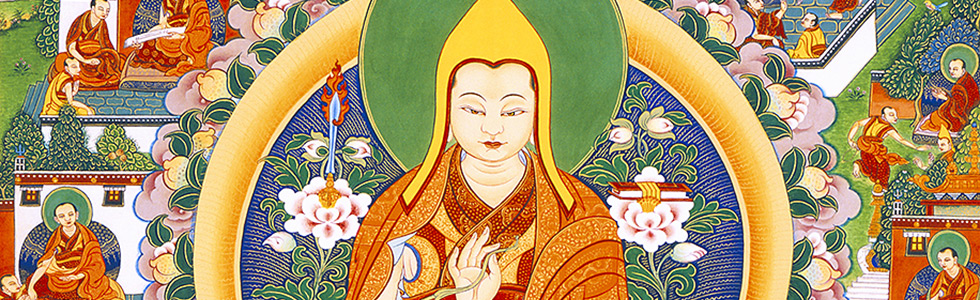
Header image: Je Tsongkhapa
Note
¹ This article, according to Prof. Williams is “substantially the same article” as the article ‘Dorje Shugden’ published in The Middle Way 1996, Vol. 71, no.2, pages 130-2. The Middle Way article ‘Dorje Shugden’ was quoted and is in the bibliography of the following research on the New Kadampa Tradition and Dorje Shugden:
- Bluck, Robert (2006), “British Buddhism”, Routledge/Curzon
- Kay, David N. (2004), “Tibetan and Zen Buddhism in Britain: Transplantation, Development and Adaptation”, Routledge/Curzon
- Chryssides, George D. (1999), “Exploring New Religions”, Continuum International Publishing Group
- Central Tibetan Administration-in-Exile, (India) (1998), “The Worship of Shugden”, Dept. of Religion and Culture, Dept. of Religion and Culture, published also by the University of Virginia
(The Middle Way article “Dorje Shugden” is possibly quoted or listed in other research but is included in the list above. Other references to it are yet to be verified.)