

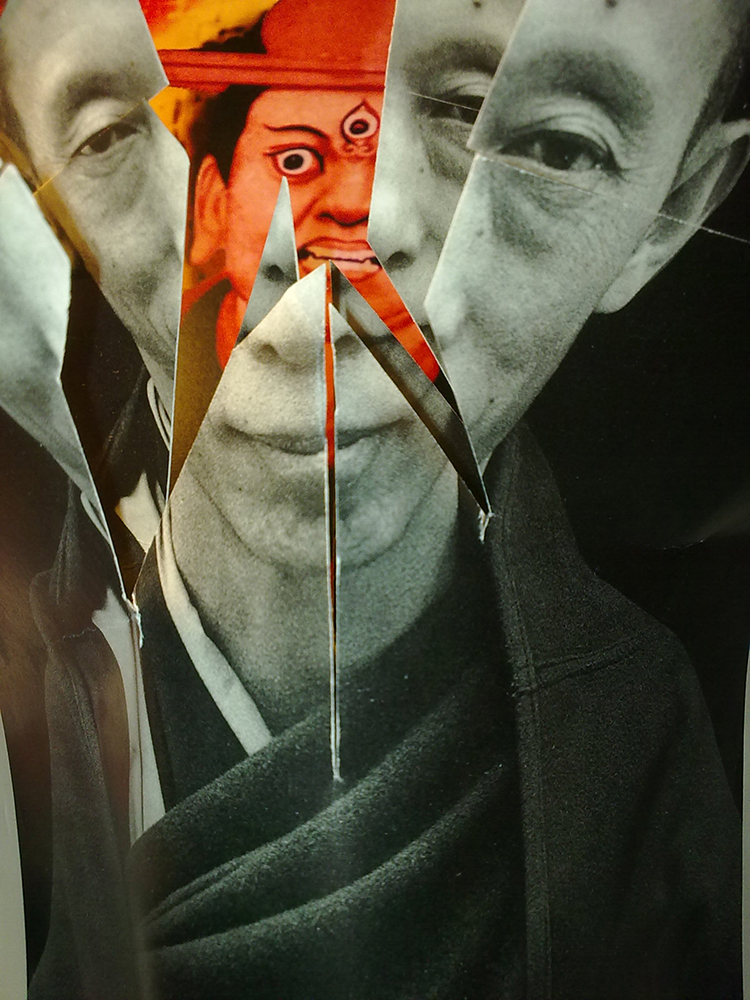
Geshe Kelsang Gyatso
Kelsang Gyatso is a Tibetan Buddhist monk, a Gelug trained teacher (scholar) and author of several Buddhist books. According to an NKT YouTube video, he was born on June 4th 1931 in Yangcho Tang, Eastern Tibet and ordained at the age of eight. According to a Tibetan published source, he was born in Toe Ngamring, near Shigatse in Tsang, South West Tibet.
In 1976 he was invited by Lama Thubten Yeshe, a Gelug teacher, to teach at his Foundation for the Preservation of the Mahayana Tradition (FPMT) center, Manjushri Institute, Ulverston, England. After creating a schism in the FPMT[1] he founded the New Kadampa Tradition (NKT) in 1991.
His present whereabouts are unknown. According to a investigative source he lives in Richardson, Texas, USA. However, Kelsang Gyatso hasn’t been seen in public since October 2013. An NKT employee claimed that Kelsang Gyatso is retired, “in strict retreat.”[1a]
Some of his teachings, writings and actions, in particular those related to Dorje Shugden, the Dalai Lama, the ordination of monastics, and the “usurpation” of FPMT’s Manjushri Institute have sparked significant controversy.
Kelsang Gyatso died on September 17th 2022 and was cremated on September 27th 2022 at Barrow Crematorium, Cumbria. There was no service. Only close family members were in attendance to watch the coffin as it was taken through to be cremated. [1aa]
Early years in Tibet
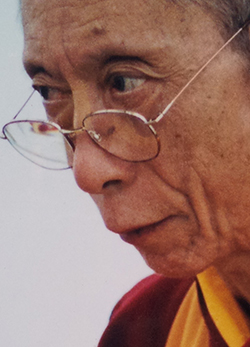
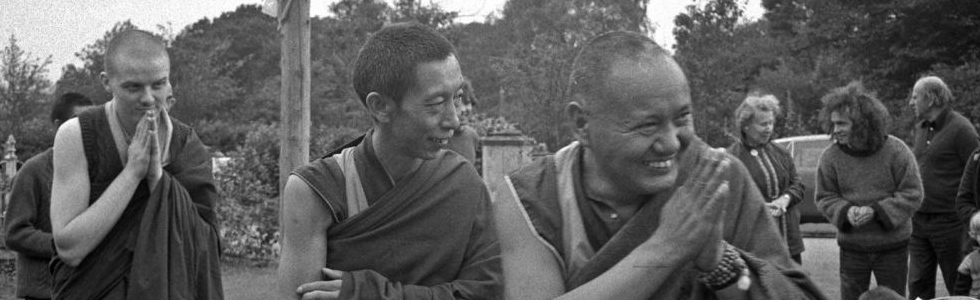
Kelsang Gyatso – seen as a source of inspiration by his followers.
There is less known about the life of Kelsang Gyatso and there are conflicting accounts.
Keslang Gyatso’s lay name is Lobsang Chuponpa. His mother’s name is Lhagchung and his father, probably born in 1903 or 1905 was named Norbu Chuyulpa. He has one brother and two sisters. His older sister is named Dekyi, the younger is Kunchok Chonyi and his niece is Ngawang Dolker. His uncle is the Choyang Duldzin Kuten Lama, a Shugden oracle.
Kelsang Gyatso claims he has recognised the reincarnation of his mother in the daughter of an English couple, Ruth and Ron Lister.[1b]
Jim Belither (NKT’s former secretary) wrote in The History of Manjushri in 1988 about Kelsang Gyatso’s early life: “His mother made great sacrifices to enable her son to attend the Ngamring Jampa Ling Monastery because he showed interest and aptitude from an early age. He joined the monastery when he was 8 years old and later described memorizing the Medicine Buddha Sutra”.
In my first monastery, Jampa Ling, this was the principal practice. The Tibetan translation of the Sutra is about fifty pages long. I memorized this together with some additional prayers, because this was one of the commitments for being able to stay in the monastery. Kelsang Gyatso
In 1939 he was ordained at Ngamring Jampaling Monastery, South East Tibet, Shigatse. He might have received the Da.ma Rabjung or gestul ordination. Full ordination (tib. gelong) can be received only from the age of 20 onward. What type of ordination Kelsang Gyatso has nowadays and who he took it from has never been clarified – this would affect the validity of his ‘authority’ to ordain others. Some Tibetan sources say that Kelsang Gytaso has a getsul (novice) ordination. A Tibetan source close to his family says, “He is fully ordained (gelong). He received the full ordination from Trijang Rinpoche in Tibet.” That Kelsang Gyatso is a fully ordained monk is more likely because if he is only a getsul he couldn’t have taken a Geshe degree because that involves study of the Vinaya which is only available to the fully ordained.
The first teacher of Kelsang Gyatso in philosophy at Ngamring Jampaling monastery was called Geshe Palden.[1d]
About his education in Tibet, Kelsang Gyatso stated in a letter to Inform, 2008:
My true situation is that in Tibet I have studied Geshe training for many years in my local monastery called Jampa Ling and Tashi Lhunpo university and I have passed two examinations. One examination is in memorization and the other is the actual examination. Soon after that people publicly used to say to me, ‘Geshe’. [3a]
Small monasteries, such as Ngamring Jampaling in local areas are simply ‘affiliated’ to larger monasteries by covering some of their syllabuses and would specialise in rituals and recitations. The Geshe degree cannot be given by Tashi Lhunpo monastery, only by Ganden, Sera or Drepung. Tashi Lhunpo awards the ‘Kachen’ degree. Exams – memorisation and debate – would generally be taken at the end of each study year. There are no dates given for his studies.
Later (the exact dates are unknown), he studied at Sera Monastery, one of the great Gelug monastic universities of Tibet. Kelsang Gyatso:
Later in Tibet I joined Sera Je monastery and I studied Geshe training further. Letter to Inform, 2008, see footnote [3a]
There was one Geshe called Geshe Jatse whom I knew well when I was at Sera monastery in Tibet. “Heart Jewel’, Geshe Kelsang Gyatso, 2002, p. 9.
Sera Je Tsangpa Khangtsen states that he received both sutra and tantric teachings from H.H. the 14th Dalai Lama when he was in Tibet – that he received the fifth Dalai Lama’s Lamrim Jampel Shalung at the Norbu Linka summer palace and the Kalachakra Initiation in 1956.[1b]
In an interview with his disciple Yvonne Nilles, Kelsang Gyatso rejected this:
I never received the Lamrim Jampel Shal-lung from His Holiness. I don’t know where they got their information from. I don’t know why the people of Sera-Je Tsangpa Khangtsen are saying this. I believe they think they are telling the truth, because they are Buddhist monks.
Of course it is true that His Holiness gave these Lamrim teachings at the Norbu Linka summer palace, but at that time I was unaware of this. When His Holiness was about to give the Kalachakra Initiation in Lhasa, I tried to join this teaching but unfortunately there were no places left, it was full. For a short while I waited with some lay people, and then I returned home. My uncle Kuten Lama knows this is true, because he was with me. So I never received the Kalachakra Initiation from His Holiness.Interview with Yvonne Nilles at Google Groups, 1998
Gen Lamrimpa’s memoir states that he sat next to Geshe Kelsang Gyatso at a Lam-rim-chen-mo teaching and an Amitayus Long-Life Initiation from His Holiness the Dalai Lama. There is also another witness who mentioned seeing Kelsang Gyatso at the Ngag-rim-chen-mo teachings.[1c]
In a YouTube video, Geshe Tashi Tsering of the Jamyang Buddhist Centre in London says he has evidence that Geshe Kelsang Gyatso “received many teachings from His Holiness the 14th Dalai Lama, including Vajrayana teachings.” As an example Geshe Tashi Tsering mentions a teaching by the 14th Dalai Lama on Je Tsongkhapa’s Nga Rim Chen Mo, The Great Exposition of the Path of Mantra. Geshe Tashi names two witnesses, Geshe Lobsang Tenzin and Geshe Lobsang Tengye. Both are still alive and both studied and lived together with Kelsang Gyasto.
This issue is significant in so far as it would imply that Kelsang Gyatso has a karmic obligation to respect His Holiness the 14th Dalai Lama as his teacher and to follow a respectful approach instead of organising international protests against the Dalai Lama with slogans and phrases that aim to insult and belittle the Dalai Lama.
In 2015, the 14th Dalai Lama said to former disciples of Kelsang Gyatso:
I know Kelsang Gyatso. … When I was in Mussoorie he gave me a copy of Gungthang Rinpoche’s writings for which I was grateful to him. … In 1981, he came to Deer Park in Madison Wisconsin to receive the Kalachakra empowerment that I was giving at the request of his teacher Geshe [Lhundup] Sopa. So although he has now taken against me, his own teacher, apparently he insists that his own students only follow him. You should continue to regard him with respect … [1g]
Life & education in India
After the exodus of Tibet in 1959, Kelsang Gyatso left Tibet and settled with Sera Je monks in Buxar, India. He stayed at the initial location of his monastery, in Buxar. Later, after Prime Minister Nehru appealed to the governments of the states of India asking if they could make land available to the Tibetans, the Sera monastery moved South. The Chief Minister of the Mysore Presidency, now Karnataka, S. Nijalingappa who was especially sympathetic to the Tibetans, made significant plots of land available. At this time, Kelsang Gyatso left the monastery at Buxar for Mussoorie (a hill station in the Indian state of Uttaranchal).
Geshe Lhundup Sopa, Geshe Rabten, and Lama Thubten Yeshe were Kelsang Gyatso’s contemporaries at Sera Je and his connections to the west.
He was a member of the Tsangpa Khangtsen, one of the fifteen houses at the monastery. As a member of that house, and a part of the general monastic community around Lhasa, he attended many public teachings, along with most of the monks and public from the area. In the 1980s a senior Gelug teacher said that Kelsang Gyatso “had done well in his studies”.
Kelsang Gyatso claims to have spent many years in meditative retreat: “In India I mainly emphasized retreat”[3a], but according to Tibetan sources Kelsang Gyatso went to Mussoorie, in Uttar Pradesh, for treatment as a chronic tuberculosis patient. (see [1b]; for more see Retreats)
According to a Tibetan source, close to Kelsang Gyatso’s family:
… later due to his ill health he joined his family at Mussoorie. During his stay at Mussoorie he continued his study by attending teachings given by two yongzins at Dharamsala. In Mussoorie he did a lot of Zyabten pujas for local Tibetans and did Mo, divinitions for his income. He did his final Geshe exam at Sera in 1970s.
According to Kelsang Gyatso, when he was not in retreat he tried “to help families by performing healing rituals and special pujas.”[1e] In Tibetan society it is common that monks, lay people or yogis do ritual service for families, to increase their prosperity, remove obstacles, cure the sick or as a blessing. Performing the ritual services is also a means to earn some money to make a living. Professional readers or ritual performers could be monastics or lay persons.[1f]
Geshe degree
Kelsang Gyatso claims to have been awarded a Geshe degree.[2] There is no account of what type of Geshe title he holds (there are five types of Geshe degree, the highest is Geshe Lharampa).
According to a documentary film published at the official homepage of HH the Dalai Lama he is a “self-styled Geshe”.[3] An Open Letter from his monastery in India, Sera Je, signed by fifteen abbots and teachers, states, “He is not even a Geshe.”[1b] The Dalai Lama said, “He was not a Geshe, but a good scholar.”[1g]
When asked, Kelsang Gyatso replied to INFORM that he didn’t accept the new system for examinations of his monastery Sera Je:
When I was living on a high mountain called Dalhousie I received a letter from Sera Je monastery. The letter gave me encouragement to go to Sera for examination. Because I had heard that the method or system for examinations was newly created therefore I did not accept this new system.[3a]
The earlier system is one set up by the 13th Dalai Lama.
Kelsang Gyasto insists in his reply to Inform that he is nevertheless a Geshe and argues “to become a real Geshe it is not necessary that the Dalai Lamas recognize them as a Geshe”.[3a]
However, taking a ‘Geshe’ title in the context of the ancient Kadampa Geshes or ‘ge wai she nyen’, the ‘spiritual friend’, would only have been appropriate centuries ago, before the Geshe title became a recognised qualification in the Tibetan monasteries. There are examples of senior Tibetan teachers who studied but did not take exams, such as Gen Lobsang Gyatso, Lama Yeshe and Lama Zopa but they did not claim or use the ‘Geshe’ title.
Acknowledgement & teachers of Kelsang Gyatso
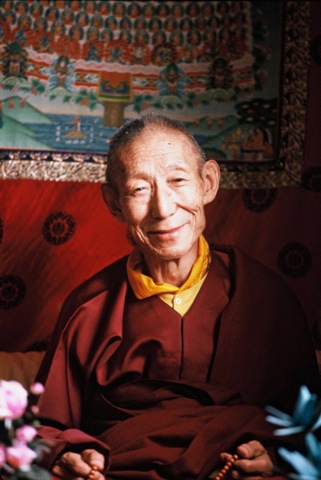
Trijang Rinpoche (1901–1981)
The 14th Dalai Lama contributed a foreword to Buddhism in the Tibetan Tradition while Trijang Rinpoche and Ling Rinpoche provided forewords for his books Meaningful to Behold (which was dedicated to the long life of the Dalai Lama) and Clear Light of Bliss (which was dedicated to the late Trijang Rinpoche), respectively. Ling Rinpoche refers to Geshe Kelsang as “this most precious Spiritual Guide,” while Trijang Rinpoche refers to him as “The excellent expounder, the great Spiritual Master Kelsang Gyatso.”
Ling Rinpoche (1903–1983), who was tutor to H.H. the 14th Dalai Lama, was the 97th Ganden Tripa (Wylie: dga' ldan khri pa, “Holder of the Ganden Throne”) in that life as well as two or three times in previous lives. Trijang Rinpoche (1901–1981), as his name implies, was the reincarnation of someone who had been Ganden Tripa in previous lives. However, he was not a Ganden Tripa in the life when he was H.H. the 14th Dalai Lama’s junior tutor.
Kelsang Gyatso rarely mentioned any teacher he had. He ususally refers to Trijang Rinpoche as his “root Guru”. In his books, Kelsang Gyatso acknowledges Trijang Rinpoche (1901–1981), Junior Tutor to His Holiness the Dalai Lama, as his teacher and “root Guru”. In his Lamrim text, “Joyful Path of Good Fortune” he states
I received these teachings from my spiritual guide Trijang Dorje Chang. The explanations given in this book […] actually come from him and not from myself. Nevertheless I have worked with great effort over a long period of time to complete the book.Geshe Kelsang Gyatso, Joyful Path of Good Fortune, Tharpa, 1990, p. xii
In “Guide to Dakini Land” Kelsang Gyatso says:
Through the kindness of my root Guru, Kyabje Trijang Dorjechang, I have had the opportunity to study and practise the instructions of Heruka and Vajrayogini. Now I have written this book as a special offering, mainly for westerners.Geshe Kelsang Gyatso, Guide to Dakini Land: The Highest Yoga Trantra Practice of Buddha Vajrayogini, Tharpa, 1991, p. xii
In his other books, Kelsang Gyatso only briefly mentions textual sources for his writing. There are no other references to receiving teachings or to other teachers. Trijang Rinpoche did not teach the classic texts of the monastic curriculum at Sera Je but ordinary monks could visit him, receive transmission or attend empowerment and in that way he could become one’s root guru.
In later years, in the US, Kelsang Gyatso is reputed to have given ‘monastic service’ to Geshe Lhundup Sopa, cleaning his room and washing his clothes. This suggests that Geshe Lhundup Sopa was his main teacher.[3b] Geshe Lhundup Sopa himself refers in his autobiography to Geshe Kelsang Gyatso as one of his “best students”.[3c] A Tibetan source, close to Kelsang Gyatso’s family, confirmed that when Kelsang Gyatso studied in Sera monastery, being a member of the Tsangpa Khamtsen, “at that time his teacher was the late Geshe Lhundup Sopa.” The 14th Dalai Lama told former disciples of Kelsang Gyatso that he himself as well as Geshe Lhundup Sopa were Kelsang Gyatso’s teachers.[1g]
Traditionally, the dates, places and teachers that Tibetan Buddhist monks receive vows and transmissions from are carefully recorded and used as evidence of appropriate qualification and experience to teach others. A comprehensive Tibetan Buddhist monastic education will include study with many different teachers. However, Kelsang Gyatso himself gives no details about when, where, and which texts he was given and under whom he studied these. The whole background about his teachers is therefore very obscure.
Though Kelsang Gyatso denies to have received both sutra and tantric teachings from H.H. the 14th Dalai Lama in Tibet (see Early years in Tibet), he said that he “attended some of his general public talks”:
Later, in India I was in Dalhousie, near Dharamsala, in the mountains doing long retreat. One day, I heard the news from my assistant that His Holiness was giving a teaching on the Great Exposition of the Stages of Tantra by Je Tsongkhapa. I decided to attend these teachings and left for Dharamsala. However, I became very sick and was unable to attend. Later, when I was in Manjushri Buddhist Centre, England, we requested His Holiness to visit, but he could not come.
It seems that I have no karma to listen to His Holiness’s Dharma teachings. Of course, in the past I have attended some of his general public talks, but that is different. Just because I attended these talks we cannot say that he is my root Guru. Interview with Yvonne Nilles at Google Groups, 1998
Retreats
According to the New Kadampa Tradition source Modern Day Kadampas:
After leaving Tibet in 1959, he spent the next eighteen years mainly emphasizing retreat in various locations in the Himalayan region and northern India … In January 1987, Geshe Kelsang entered a three-year retreat at Tharpaland in southern Scotland. Although Geshe-la gave no formal teachings during this time, in-between his meditation sessions he continued to work on a number of books, and it was during his stay at Tharpaland that he completed Joyful Path of Good Fortune and Universal Compassion, and wrote The Meditation Handbook, Introduction to Buddhism and Guide to Dakini Land. It was also during this period that he designed the three spiritual programs that form the core of the New Kadampa Tradition.[5]
However, according to Kelsang Gyatso’s monastery Sera Je,
When the Sera Monastery was transferred south India from Buxa[r], he left the monastery for Mussoorie (a hill station in the Indian state of Uttar Pradesh) and stayed there as a chronic T.B. patient. … On top of it he has used his stay in Mussoorie as a publicity stunt as having “meditated in the Indian Himalayas for fifteen years”!!![1b]
Other sources say he went to Mussoorie, Uttarakhand, where his family was documented working and receiving social support within the Tibetan exile community in the 1980s.
Kelsang Gyatso himself said to Yvonne Nilles:
I did a long retreat for many years in Nepal near the border of Tibet in the Himalayan region. The place is called Bangthog Damthang, and I was sponsored by my sister Dekyi who is now living in Switzerland. Later, I did many long retreats in the Dalhousie mountains near Dharamsala. In Mussourie, every winter for several months I did retreat. When I was not in retreat I was trying to help families by performing healing rituals and special pujas. Before I went to Mussourie I lived in Buxa and fell sick there with recurrent chest infections, but it was not serious. Later, in Mussourie the chest infections continued to recur, but I was never admitted to hospital. In this life, I have never spent even one night in hospital! My relatives in Mussourie were urging me to have a thorough check up so I was examined by three different doctors. Two of them said that I had no disease, but that I needed to build up my bodily strength, and one doctor said that maybe I had TB. In reality it was difficult to understand the real problem. Later, when I was living in England, I experienced continual physical weakness until finally I went with two Western assistants to London for three weeks and was examined by two specialists. They took many X-rays and did many other tests. The final result was that both doctors said there was no disease, just lung weakness. They said I needed fresh air, sunshine, exercise and rest to build up my strength.Interview with Yvonne Nilles at Google Groups, 1998
During his three-year meditative retreat in Scotland, Kelsang Gyatso “invited a geshe from Ganden Shartse monastery in South India, Geshe Losang Pende, to teach the General Programme in his absence, whilst Geshe Konchog Tsewang continued to run the Geshe Studies Programme.” (Kay 2004: 73)
Journey to the West, Schism with the FPMT, Foundation of the NKT
In 1976 Kelsang Gyatso was invited by Lama Thubten Yeshe and Lama Zopa Rinpoche[4] to teach at Manjushri Institute, a center in England founded by Lama Yeshe in 1975. Geshe Kelsang arrived in England in late August 1977.[5] He was invited to Manjushri Institute in the UK to teach basic Buddhism – not the ‘Geshe’ program taught by Geshe Jampa Tekchog and later Geshe Konchog Tsewang – and access the health treatment he needed, by Lama Yeshe, of the Foundation for the Preservation of the Mahayana Tradition (FPMT). The FPMT is a Tibetan Buddhist group teaching westerners, who had created Manjushri Institute as a new and major Tibetan Buddhist educational centre for Europe.
Lama Yeshe intended the Institute to ‘become the central monastery of the FPMT […] one of the early jewels of the FPMT crown’. The Institute was intended to be ‘the pioneer among the western centres […] the model on which FPMT centres would pattern themselves’.[6a]
The late Geshe Jampa Tekchog staid:
We talked about what kind of teachers to bring to the West, and we thought that it would be best not to send the highest geshes to teach beginners. We thought that when a firm base was established, then more qualified teachers could be invited.
Kelsang Gyatso states
When I was in India I received an invitation from Manjushri Institute in England through Lama Yeshe, who was my very close friend in Tibet. He and I were from the same monastery in Tibet and we had the same Teacher. He wrote to me and requested me please to go to England and give Dharma teachings. I received this invitation but I didn’t answer for two months. At that time it was difficult for me to say yes due to certain commitments to local Tibetan people, and also I thought how could I teach as I could not speak English? I had no confidence. Lama Yeshe was very clever; he went to visit my root Guru Kyabje Trijang Rinpoche, and requested him to ask me to go to England to teach Dharma. He knew if my root Guru asked me, then I would agree to go. Interview with Yvonne Nilles at Google Groups, 1998
According to NKT Trijang Rinpoche suggested that Geshe Kelsang should teach Lamrim, Chandrakirti’s Guide to the Middle Way and Shantideva’s Guide to the Bodhisattva’s Way of Life and then check whether it was suitable to remain. Geshe Kelsang arrived at Manjushri Institute in late-August 1977. (History of Manjushri, Rodamor, Tyson and Belither) However, according to researcher David N. Kay, Kelsang Gyatso was invited in 1976 by Lama Thubten Yeshe and Lama Zopa Rinpoche, “who apparently sought the advice of the Dalai Lama when choosing Geshe Kelsang.” (Kay 2004: 56)
With Tenzin Paksam Phunrabpa (sometimes called Tenzin Norbu) as translator, Kelsang Gyatso gave teachings at FPMT’s Manjushri Institute on Shantideva’s Bodhisattvacharyavatara (Guide to the Bodhisattva’s Way of Life), Guru Yoga (Lama Chopa), Vajrayana Mahamudra, an ‘oral commentary of the instruction of Vajrayogini’, The Stages of the Path (Lamrim), the Heart Sutra, Eight Verses of Training the Mind by Langri Tangpa and Training the Mind in Seven Points by Geshe Chekhawa. Tenzin P. Phunragpa is also credited as translating Kelsang Gyatso’s commentary to Chandrakirti’s Guide to the Middle Way, although editions of the book itself do not have this information.
1978–1984: Provoking a schism[1], Kelsang Gyatso eventually kept the FPMT’s ‘mother centre’ as his own – a mock Victorian castle on 150 acres of land – and expelled Lama Yeshe’s remaining students. In 1982 Kelsang Gyatso became a naturalized British citizen.[7]
Thubten Gonpo – an early openly outspoken critic of the NKT – commented on the so-called “Blackmail tape” which was delivered on July 22, 1983 by Chip Rodarmor (Kelsang Gyatso’s messenger) and Tenzin Paksam Phunrabpa (Kelsang Gyatso’s translator) to Lama Yeshe at Vajrapani Institute on July 22, 1983:
However, at Lama Yeshe’s request the Dalai Lama asked Kelsang Gyatso to leave Manjushri in Autumn of 1983 and repair to York and live in Kelsang Gyatso’s own center there, the Madhyamaka Centre. His Holiness did this by sending his brother to Conishead Priory to discuss this with Kelsang Gyatso. Obviously, Kelsang Gyatso was not swayed by this emissary of the Dalai Lama.Thubten Gonpo – Phayul discussion forum entry Mar 20 2005 09:37 AM
Non-NKT sources say that this emissary from the Dalai Lama was Kelsang Yeshi who went on to become a religious Kalon and later Kalon Tripa.[6b] The Dalai Lama Lama confirmed that he “sent an official to try to mediate.”[1g]
According to Kay, in February 1984 the conflict was mediated by the Office of His Holiness the Dalai Lama in London.[6b] A Tibetan source says that Ling Rinpoche and Trijang Rinpoche – the elder and the younger tutor of the 14th Dalai Lama, Tenzin Gyatso, respectively – tried to settle the Manjushri Institute controversy because they felt it to be very damaging to Tibetan Buddhism in the west but “Kelsang Gyatso didn’t listen to anybody” and so they had no success.[6d]
At the time of the Madhyamaka Centre dispute in 1979 – described by Kay as the beginning of a conflict between Kelsang Gyatso and Lama Yeshe – Kelsang Gyatso refused to sign a Geshe Agreement with which he had been presented by the FPMT, claiming, “I have had nothing to do with the FPMT before or after 1979”.[6b]
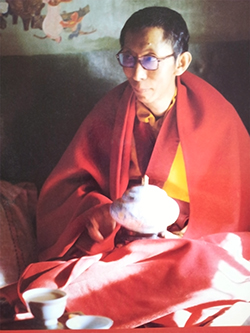
On the back of the photo it says: “In 1986 Geshe-la visited Tibet in order to oversee the rebuilding of Nyamring Monastery where he was ordained. The photo was taken in Lhasa at the home of a friend of Geshe-la’s.”
Gradually, Kelsang Gyatso isolated the Manjushri Institute and all of his students from the wider Buddhist world – from Buddhist teachers, the Buddhist community, Buddhist monks and nuns etc. who do not rely exclusively on him as their final Buddhist authority. The last step to accomplish this isolation was the provoked retirement of Geshe Konchog Tsewang who taught the more sophisticated Geshe Studies Programme at Manjushri Institute until 1991. According to a Tibetan source, Kelsang Gyatso presented him two options, either Geshe Konchog has to accept a business plan for his teaching actvities in which income and costs are calculated and if there is a minus he will be fired like in any other business or Geshe Konchog has to accept a retirement fee which is paid if he goes back to India. Geshe Konchog decided for the latter.[6d] Prior to this, in 1990, Kelsang Gyatso became outspoken against the Geshe Studies Programme[6e], and “made the pursuit of his [own] new programmes compulsory.”[6e] Therefore, Geshe Konchog’s decision might be based on the less encouraging context: “… the basis of Geshe Konchog’s teaching programme at the Institute was undermined, and in 1991 he retired to Gyuto Monastery in Assam, India”.[6e]
Finally, Kelsang Gyatso “split away from this organisation [FPMT] to develop a parallel network of his own that he later unified and gave a distinct identity as the NKT.”[6] In the process of that split, Kelsang Gyatso became the spiritual head of Manjushri Institute and founded the New Kadampa Tradition in 1991 (see NKT history).
Nowadays the Manjushri Institute is called Manjushri Kadampa Meditation Centre. In 1991, “through the successful exploitation of a legal loophole”,[6c] it became the main seat of the New Kadampa Tradition and Kelsang Gyatso.
In 1992 Kelsang Gyatso stopped giving twice weekly teachings to the community at Manjushri and concentrated to establish world wide NKT Dharma Centres. He teaches rather rarely. In general he gives teachings and empowerments two times a year during NKT Spring and Summer Festivals in different countries to which his devotees travel from around the world.
Books, programs and centres
With the main purpose to publish Kelsang Gyatso’s edited oral teachings, a team of editors was set up that included Neil Elliott and Lucy James, currently still senior teachers in the NKT. Kay states:
This activity became particularly important to him at this time and was to play a central part in his unfolding vision of the NKT. By giving his study programmes a textual basis, Geshe Kelsang not only provided accessible materials to enhance the focus and commitment of his students, but also laid down structures through which spiritual authority could later be concentrated exclusively in him.
Three new texts by Geshe Kelsang were published between 1984 and 1988: Buddhism in the Tibetan Tradition: A Guide (1984), Heart of Wisdom: A Commentary to the Heart Sutra (1986), and Universal Compassion: A Commentary to Bodhisattva Chekhawa’s Training the Mind in Seven Points (1988). Kay 2004: 75
Kelsang Gyatso’s books were first published by Wisdom Publications. But when Kelsang Gyatso founded Tharpa Publications in 1985, Tharpa became gradually the exclusive publisher of his own books.
However, Tharpa Publications was originally a general Buddhist publishing house,[6f] and described itself as follows:
Drawing from all traditions of Buddhism, our main purpose is to preserve and make available the authentic teachings of Mahayana buddhist thought and practice.[6g]
Tharpa Publications released the following works by Sangharakshita and Geshe Rabten:
- The Eternal Legacy: An Introduction to the Canonical Literature of Buddhism, Tharpa Publications (1985) by Sangharakshita, ISBN 0-948006-02-1.
- A Survey of Buddhism: Its Doctrines and Methods through the Ages, Tharpa Publications (1987) by Sangharakshita, ISBN 0-948006-01-3.
- Treasury of Dharma: A Tibetan Buddhist Meditation Course, Tharpa Publications (1988) by Geshe Rabten, ISBN 0-948006-04-8.
Kelsang Gyatso’s later books – Understanding the Mind (Lorig), 1993, Tantric Grounds and Paths (Uncommon Vajrayana Mahamudra), 1994, and Essence of Vajrayana (Heruka commentary) 1997, do not state they are edited from oral teachings. They appear to be written as books and no evident transmission of the complete texts has been given except perhaps to his early students. Only a brief oral commentary was given on the ‘new’ Heruka practices in 1997.
Kelsang Gyatso, in general, credits few works in his own books. He states that he has based his Heruka and Vajrayogini commentaries on Je Tsongkhapa’s text “Illumination of Hidden Meanings”. His Guru Yoga as explained in Great Treasury of Merit (1992) is based on the First Panchen Lama’s works. Je Tsongkhapa’s Lamrim Chenmo and Pabongkha’s work are also quoted by him as sources. Kelsang Gyatso’s later books are almost completely self-referential – listing only his own books as references in the text.
There are no other texts taught in the NKT except simpler, edited versions of these same texts. It could be questioned therefore, if Kelsang Gyatso studied further than these texts would suggest. He told his students in one NKT Summer Festival that he had translated the Perfection of Wisdom Sutra in 8,000 lines but that as students we “weren’t ready for this” and had to practice and purify more. This book has not been published.
Until 2014 Kelsang Gyatso wrote twenty-one books that – according to NKT – aim to provide Western Dharma practitioners with essential Buddhist texts. Two of his books are commentaries on Indian Mahayana texts: the book Ocean of Nectar (1995) is a commentary on Chandrakirti’s Guide to the Middle Way, and Meaningful to Behold (1980) is a commentary on Shantideva’s Guide to the Bodhisattva’s Way of Life or Bodhicharyavatara. The Book Modern Buddhism – The Path of Compassion and Wisdom (2013) is promoted for free as a digital version.
Furthermore, he has established three study programmes in his Dharma Centres, called the General Programme, Foundation Programme and Teacher Training Programme respectively. In these programs people can study Kelsang Gyasto’s books with authorized NKT teachers.
Since the foundation of the New Kadampa Tradition in 1991 many NKT centres were founded worldwide. According to NKT in 2015 there are “1100 Kadampa Centers and branches in 40 countries around the world”.[8] The vast majority of these Kadampa Centers are groups at local places, such as rented rooms in libraries, local community centres, and members’ apartments.[8]
NKT claim that Kelsang Gyatso’s teachings “are especially suited to the modern world.”[9]
According to Waterhouse, the doctrinally conservative nature of his teachings and the traditionally structured and direct style in which they are presented in his texts reflects his background within the rigorous scholastic and academic training system of Sera Je monastic training system.[10]
According to Kay, Kelsang Gyatso follows a strongly ‘clerical’ orientation, as Pabongka Rinpoche did. Kay states further:
For Geshe Kelsang the faithful transmission and continuation of the tradition as it was taught to him has been much more important than adapting the teachings or innovating new ones for westerners. His allegiance to the protective deity Dorje Shugden, also traced back through Trijang Rinpoche and Pabongka Rinpoche, forms another key element of his clerical and exclusive outlook. The clerical and exclusive character of Geshe Kelsang’s thought, however, has not been static and fixed throughout his career. His concern with the conservation and preservation of the tradition of Tsongkhapa became increasingly urgent during the time in the West and his exclusivism hardened and intensified.[11]
Teachings
Faith, devotion and reliance
Kelsang Gyatso has firmly encouraged faith and devotion in his followers, describing faith as “the root of all virtuous qualities and spiritual realizations.”[12] ‘Faith’ is described by Kelsang Gyatso as “a naturally virtuous mind that functions mainly to oppose the perception of faults in its observed object.”[13] He encourages members to “be like a wise blind person who relies totally upon one trusted guide instead of attempting to follow a number of people at once”,[14] stating further that “Experience shows that realizations come from deep, unchanging faith, and that this faith comes as a result of following one tradition purely – relying upon one Teacher, practising only his teachings, and following his Dharma Protector.”[15] Kelsang Gyatso stated also that a practitioner should check to see whether or not Spiritual Teachers and their teachings are authentic or not, and not to follow them simply based upon their good reputation.[16] Bluck states that members were encouraged to investigate doubts rather than ignore them.[17] However, according to Kelsang Gyatso spiritual success is based on “unwavering faith and confidence” and “it is essential to eliminate those doubts that interfere with the development of pure faith.”[18]
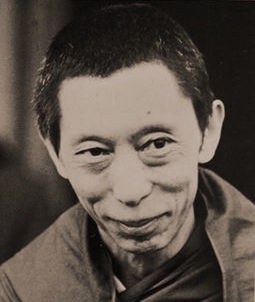
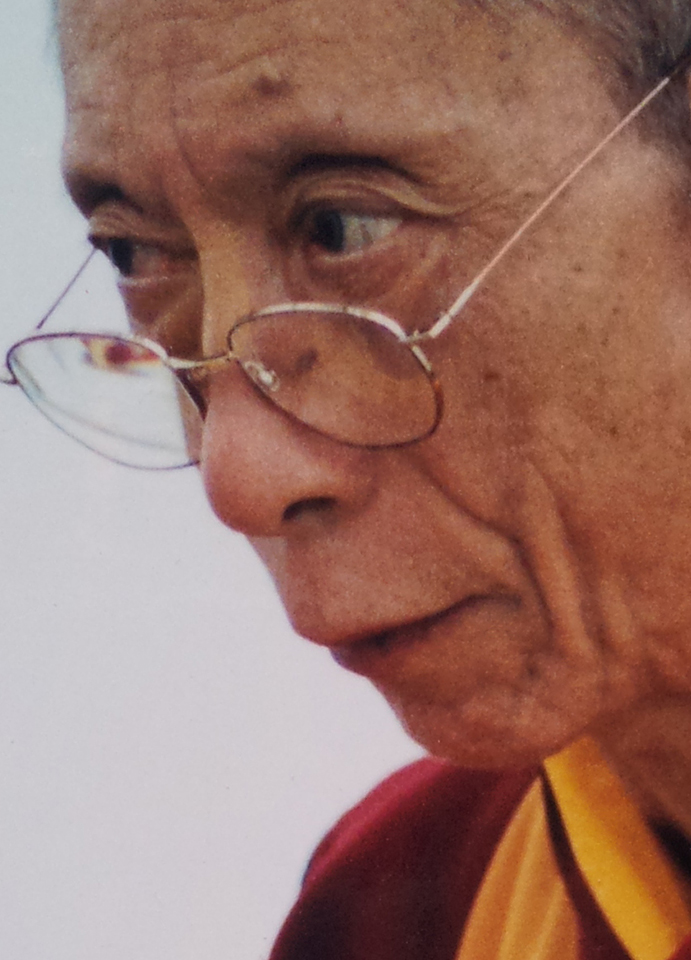
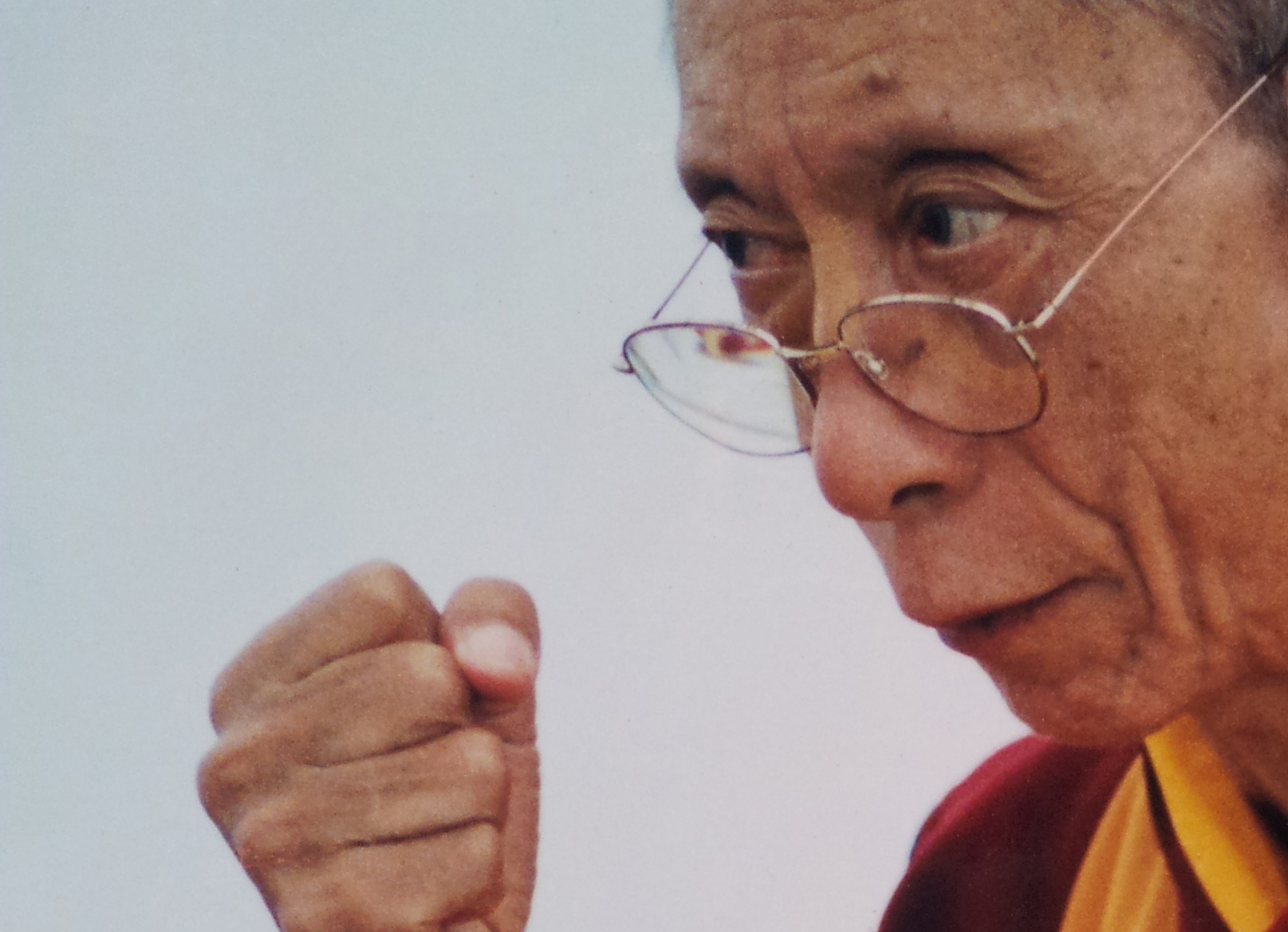
Geshe Kelsang Gyatso
Kay found that in general the teachings and practices of Geshe Kelsang are mostly in-line with the presentation of other Tibetan Gelug teachers[19] and that the importance of cultivating a mind of faith and devotion in a qualified Guru or Lama is a fundamental element of all Tibetan Buddhist belief and practice. This is especially so in personal Tantric practice where the Guru may be explicitly combined and identified with the Yidam (meditational deity). Nevertheless, Kelsang Gyatso’s teachings on this subject have changed and developed during his time in the West, and they now incorporate a number of unusual features.
According to Kay:
The main shift in his thought occurred with the creation of the NKT. Discussions of the guru-disciple relationship appearing in his publications from this time reflect an exclusivism that did not characterise his earlier presentation and which is uncommon within traditional Tibetan contexts. Geshe Kelsang’s texts list the traditional qualities that should be possessed by the ideal spiritual teacher, and he encourages students to check these qualifications thoroughly before relying upon someone as a spiritual guide. This attitude of critical enquiry should be retained throughout a person’s spiritual career.[20] Since the creation of the NKT in 1991, this teaching on the importance of personal authority in negotiating the Buddhist path has been overshadowed by an emphasis upon developing ‘unwavering faith and confidence’ in the guru and upon having faith in the teachings ‘even if we do not fully understand them’.[21] The exclusive emphasis on the authority of Geshe Kelsang is also reflected in the texts. The earlier view that practitioners ‘must depend upon the advice of experienced guides – fully qualified spiritual masters – and meditate according to their instructions’[22] was replaced following the NKT’s creation with the narrower claim that they must ‘rely upon a qualified Spiritual Guide and practise precisely according to his or her instructions’.[23] According to Geshe Kelsang, the student must now ‘be like a wise blind person who relies totally upon one trusted guide instead of attempting to follow a number of people at once’.[24] The emphasis Geshe Kelsang placed in his earlier texts upon adopting an exclusive approach to one’s spiritual tradition was continued following the creation of the NKT. However, this teaching now took place within the organisational and ideological context of the NKT, and it was combined with the new teaching that one should rely exclusively upon only one trusted spiritual guide. Whereas the injunction about committing oneself to a single tradition was previously an attempt to encourage students to practise only the teachings of Lamas within the Gelug tradition of Tibetan Buddhism, it now became an injunction to practise only within the NKT … Similarly, whilst the teaching that students should only rely upon teachers who ‘share the same lineage and view as our principal Spiritual Guide’[25] is not an uncommon view within Tibetan Buddhism, where lamas will often encourage students to study under others who have a similar orientation to themselves, this teaching carried a very specific and untraditional meaning within the context of the NKT. Since students within the organisation have only one spiritual guide, the teaching is in practice an injunction to study only under Geshe Kelsang and teachers who have trained under him. Even the most exclusively orientated Gelug lamas, such as Pabongka Rinpoche and Trijang Rinpoche, do not seem to have encouraged such complete and exclusive reliance in their students as this.[26]
Compassion, generosity, Bodhicitta, and Tantra
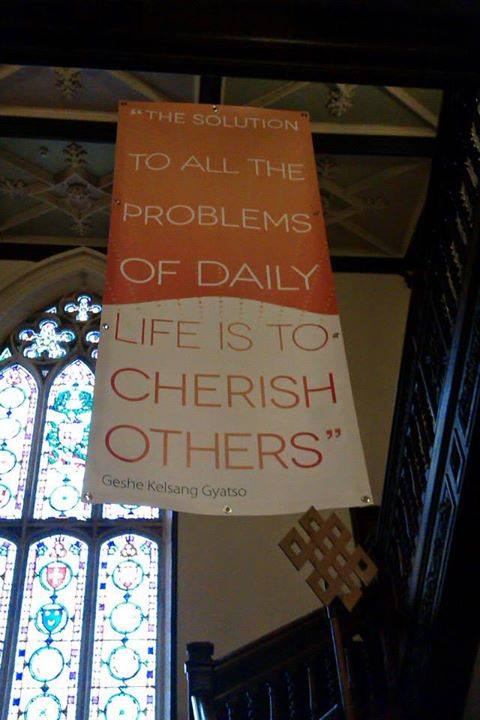
“The solution to all the problems of daily life is to to cherish others.” NKT banner.
Kelsang Gyatso stresses in his teachings “to maintain a special experience of inner peace,” to promote “lasting happiness,” and to “replace negative mental states with positive ones”. The traininng in compassion and generosity are also repeatedly emphasised by Kelsang Gyatso.[27] This training includes the practice of cherishing other beings, taking upon oneself their suffering, and wishing them to be happy. He teaches that wishing others to be happy will enable practitioners “to be born as a human or god, to have a beautiful body in the future, and to be loved and respected by many people.”[28]
Other key elements of Kelsang Gystso’s teachings are a focus on Bodhicitta and generosity and their benefits, taking refuge in the Three Jewels (Buddha, Dharma and Sangha) and encouraging others to do the same, and fearing lower rebirth and Samsara. Quoting Waterhouse (1997: 173), Bluck says that “the teaching on the hell realms was used to encourage followers ‘not to break their commitments for fear of future suffering.’ Although familiar in Tibetan Buddhism, this is rarely mentioned in Britain outside the NKT.”[29]
The central Highest Yoga Tantra practice in NKT is Vajrayogini. Kelsang Gyatso only bestows Heruka/Vajryayogini Highest Yoga Tantra empowerments. This is another aberration from the traditional Gelug context where the combination of the three Highest Yoga Tantra deities Guhyasamaja, Yamantaka and Heruka form the very nucleus of Tsongkhapa’s Vajrayana (Tantra) tradition. Guhyasamaja and Yamantaka empowerments are not given in the NKT.
Newcomers reported to have been strongly encouraged or even felt forced by group pressure to attend Vajrayogini empowerments. When they raised concerns about the concomitant Vajrayana commitments they were told not to worry, but once they took the Vajrayogini empowerment they were told that now Kelsang Gyatso was their “root guru” – implying that leaving him or the NKT will be punished with rebirth in the hell realms and not being able to meet qualified Buddhist masters in future lives once being born again as a human.
Kay reported,
some regard the NKT as a narrow distortion of the history and practice of Tsongkhapa’s original Gelug formulation. Kay 2004: 93
All in all it might be safe to say that Kelsang Gyatso’s approach is to give westerners a very simplified and easily digestible form of complex Indo-Tibetan Buddhism. He also simplified key elements of the NKT, such as the Dorje Shugden and the ordination practice, deviating from how it was taught and transmitted to him. This easy digestible form of Tibetan Buddhism is further mixed with hopes for quick results that can be attained very easily by relying on “faith in Geshe la” and “accumulating merit” (by mainly establishing NKT Dharma Centres and spreading NKT and Kelsang Gyatso’s books worldwide) and fears to pollute “this stainless tradition” or to leave the “root guru”, Kelsang Gystso, or to fall prey to the “very degenerated Tibetan Buddhism” that is localized by Kelsang Gyatso to lie outside of the NKT. (see his ordination talk)
Simplifications of complex Indo-Tibetan Buddhism, and especially of Kelsang Gyatso’s own tradition, Tsongkhapa’s tradition (the Gelug school) might have a very appealing effect to many westerners who lack time to commit themselves full time to Buddhist studies and practices, to learn Tibetan and to study the great treatises of Je Tsongkhapa and his disciples Khedrup Je and Gyaltsab Je and other great texts of this tradition. Such an approach also might give space for NKT followers to work more for the spread of NKT over the whole world, but in the long run the subtleties and profundity of the lineage NKT claims to hold might get lost, and black and white ideas of Buddhist concepts might prevail that block deeper understandings and experiences. For instance, on different occasions Ex-NKT and observers have accused NKT of teaching Nihilism, denying conventional reality.
Mixing hope and fear into Buddhist teachings might serve as a vehicle to bind newcomers and long term members emotionally to NKT – Ex-NKT have accused NKT of manipulating feelings of hope and fear, self-confidence and guilt – but it doesn’t set people’s minds free.Dorje Shugden / Dolgyal
Because the practice of Dorje Shugden / Dolgyal was transmitted by Trijang Rinpoche to Kelsang Gyatso, and Kelsang Gyatso wants to keep this practice up, he continues to teach and follows this practice.
However, he teaches Shugden to his followers in a very simplified form.
Traditionally, this practice was performed in private or in a specially devoted shrine room. Kelsang Gyatso has since brought it into the open to be performed in the main shrine room. Also the outer appearance of Shugden has changed from a wrathful deity to a gentle protector.
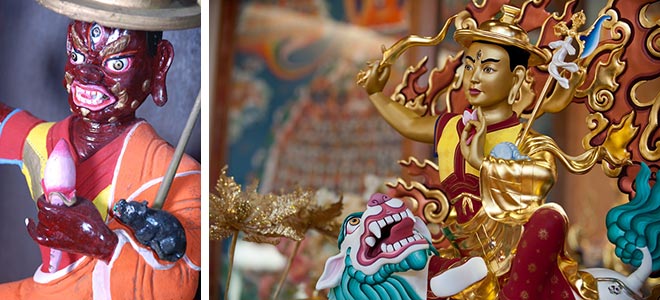
left: Statue of Dorje Shugden / Dolgyal, traditionally posed as a “wrathful deity”.
right: Statue of Dorje Shugden / Dolgyal by the NKT, deprived of its wrath and depicted as a peaceful “Wisdom Buddha”.
Statues of Shugden are usually prominently displayed on the main shrine of any NKT Dharma Centre together with statues or images of Buddha Shakyamnuni and Tsongkhapa and other religious figures who are important within the NKT. Practiced daily by faithful NKT followers, the Heart Jewel Sadhana contains the Tsongkhapa-Guru-Yoga practice (Tib. Ganden Lha Gyäma) combined with a condensed version of the Dorje Shugden Sadhana.
The free e-book Modern Buddhism – The Path of Compassion and Wisdom totally avoids even mentioning Dorje Shugden by name and speaks instead of “Wisdom Dharma Protector” (p. 148) or “Wisdom Buddha Je Tsongkhapa Losang Dragpa”. (p.181)
Kelsang Gyatso has described Dorje Shugden as an enlightened Dharma protector, ’jig rten las ’das pa’i srung ma, a manifestation of the Wisdom-Buddha Manjushri and stated:
From the time of Je Tsongkhapa until the first Panchen Lama, Losang Chökyi Gyaltsän, the principal Dharma Protector of Je Tsongkhapa’s lineage was Kalarupa. Later, however, it was felt by many high Lamas that Dorje Shugden had become the principal Dharma Protector of this tradition.[30]
He claims:
There is no difference in the compassion, wisdom, or power of the various Dharma Protectors, but because of the karma of sentient beings, one particular Dharma Protector will have a greater opportunity to help Dharma practitioners at any one particular time … These days, however, we do not have such karma, and so Buddha appears to us in the form of our Spiritual Guide and helps us by giving teachings and leading us on spiritual paths. Thus, the form that Buddha’s help takes varies according to our changing karma, but its essential nature remains the same … However, the beings of this present time have a stronger karmic link with Dorje Shugden than with the other Dharma Protectors. It was for this reason that Morchen Dorjechang Kunga Lhundrup, a very highly realized Master of the Sakya tradition, told his disciples, ‘Now is the time to rely upon Dorje Shugden.’ He said this on many occasions to encourage his disciples to develop faith in the practice of Dorje Shugden. We too should heed his advice and take it to heart. He did not say that this is the time to rely upon other Dharma Protectors, but clearly stated that now is the time to rely upon Dorje Shugden.[30]
Kelsang Gyatso described the benefits of relying upon Dorje Shugden as follows:
If we can understand well the nature and functions of Dorje Shugden, we can understand the benefits of relying upon him. Dorje Shugden always helps, guides, and protects pure and faithful practitioners by granting blessings, increasing their wisdom, fulfilling their wishes, and bestowing success on all their virtuous activities … We should understand that the principal function of a Dharma Protector is to protect our Dharma practice, not to help our mundane affairs. Bearing this in mind we should not become discouraged if we do not suddenly become very wealthy, for wealth does not necessarily help spiritual practice and can be a great distraction …[30]
The root guru of Kelsang Gyatso, Trijang Rinpoche, junior tutor of the 14th Dalai Lama, described Shugden in Music Delightning an Ocean of Protectors[30a] as a mundane (ie. worldly) protector (p. 11), a damsi (vow breaking) spirit (p. 107) and a gyalpo spirit called Dolgyal (p. 109) that harms and kills sentient beings (p. 111–122). About the violence Shugden brings to other sentient beings Trijang Rinpoche states (p. 121–122):
Furthermore, whether they were lords of Tibet, great lamas who held the political power of the throne, lamas and tulkus, great or small, with illustrious lines of incarnation, holy beings rich in scriptural and realized qualities, high lords of vast lands and works, those haughty with pride of family lineage, dominion and wealth, any who hypocritically claimed to be followers of Protector Manjusri Tsongkhapa's Teachings while remaining unsatisfied with Je Lama's precious Teachings of Sutra and Tantra which, in terms of view, meditation, and action, need not crave more from any other tradition, and, instead, mixed, polluted, or confused them with other modes of view and practice, whether lay or ordained, regardless of status, there have been many who have met with unpleasant wrathful punishments, such as being punished by authorities, litigation and legal disputes, untimely death, and so forth. Such swift, decisive signs appear to direct perception. Here praise is offered to that manifestation as a great wrathful protector who raises the Yellow Hat Teachings to the heights of the heavens.
According to Trijang Rinpoche, this harmful violent spirit is an emanation of Manjushri who emanated for the special purpose (p. 9) of protecting the purity of Tsongkhapa’s tradition and stopping Gelugpa’s taking teachings from other traditions.
Academic research suggests that Shugden was generally considered a mundane (unenlightened) protector (’jig rten pa’i srung ma)[30b] and
that the position which defines Dorje Shugden as an enlightened being is both a marginal viewpoint and one of recent provenance. Kay 2004: 230
The 14th Dalai Lama – the pre-eminent spiritual authority in Tibet – “has rejected and spoken out against this practice. He has described Shugden as an evil and malevolent force, and argued that other Lamas before him had also placed restrictions on worship of this spirit.”[31]
Besides the Dalai Lama and former Ganden Tripas (formal heads of the Gelug tradition), who have also spoken against the Dorje Shugden practice, there are high-level Lamas who have warned of the dangers of this practice. According to the The Dolgyal Research Committee (Tibetan Government in Exile), prominent opponents include the 5th, 13th and current Dalai Lamas, the 5th and 8th Panchen Lamas, Dzongsar Khyentse Chokyi Lodro, the 14th and 16th Karmapas among others.[32] Also Namkhai Norbu Rinpoche, a Dzogchen master, “has been insisting on the importance of failing to appreciate the danger inherent in such cults.”[33]
Tibetan Lamas who put emphasis on that practice, besides Kelsang Gyatso and others, include: Pabongka Rinpoche, Trijang Rinpoche, Song Rinpoche, Gonsar Rinpoche, and Dagom Rinpoche. For more Dorje Shugden devotees, see the Dorje Shugden article.
Based on Kelsang Gyatso’s efforts the different views on Dorje Shugden led finally to a public dispute in the West and were largely reported by the media. Kelsang Gyatso organised public protests against the Dalai Lama via the Shugden Supporters Community (SSC) from 1996–1998. Those demonstrations and the related press campaign have been named by Bunting “an aggressive international smear campaign to undermine the Dalai Lama”[34], whereas Kelsang Gyatso stated, “Demonstrating was telling him [the Dalai Lama] that he made a mistake. Demonstrating should have been a teacher for him. Demonstrating was loving him, not disrespecting him, not harming him. But he never changed.”[35]
In 1998 Kelsang Gyatso stopped that campaign, stating, “we decided to completely stop being involved in this Shugden issue because we realized that in reality this is a Tibetan political problem and not the problem of Buddhism in general or the NKT.”[36] However, in 2008 he organised new waves of international protests against the Dalai Lama going along with a highly professional media campaign. For this purpose NKT founded new front organisations, in 2008 the Western Shugden Society (WSS) and in 2014 the International Shugden Community (ISC).
The controversy regarding the Dorje Shugden practice is described in the article on the Dorje Shugden Controversy.
Sectarianism
The Oxford Advanced Learner’s Dictionary describes sectariansm as:
… strong support for one particular religious or political group, especially when this leads to violence between different groups[36a]
Other mundane sources explain being sectarian as:
… rigidly following the doctrines of a sect or other group: the sectarian Bolshevism advocated by Moscow.[36b]
The Sakya master Deshung Rinpoche explains sectarianism from a Buddhist point of view as follows:
Whenever we act simply out of attachment to our own order or from a wish not to be receptive to the teachings or teachers of other orders, we are indulging ourselves in this very harmful attitude of sectarianism.[36c]
He adds:
People who adopt this narrow-minded attitude of sectarianism are usually ignorant of the doctrines that other orders possess. Instead they base their sectarianism upon lineage. They reject the teachers, rather than the teachings of other schools.
Sectarianism turns the pure Dharma into poison. Through it, one accumulates great sin. In this life one will be frustrated in one’s own Dharma efforts. Upon death, one will fall into hell as swiftly as an arrow shot from a bow. These are the consequences of spending a lifetime in rejecting others’ spiritual efforts on such narrow-minded grounds.
Therefore be mindful not to indulge in this attitude that brings so much unsought harm upon yourself. Do not create obstacles to your own Dharma. Strive instead for pure faith and maintain that faith in all manifestations of the Three Jewels, no matter whether they are represented in one school of Tibetan Buddhism or in another. Painstakingly nurture your refuge vows and pure faith and thereby grow truly in the Dharma.[36c]
In his Lam Rim Chen Mo, Je Tsongkhapa doesn’t use the term sectarianism but writes about being partisan and nonpartisan. Being nonpartisan is one of three defining characteristics[36d] of the student who relies upon the teacher[36e]. He explains:
With respect to these three characteristics, “nonpartisan” means not to take sides. If you are partisan, you will be obstructed by your bias and will not recognize good qualities. Because of this, you will not discover the meaning of good teachings. As Bhavaviveka states in his Heart of the Middle Way (Madhyamaka-hrdaya):
‘Through taking sides the mind is distressed,
Whereby you will never know peace.’
‘Taking sides’” is to have attachment for your own religious system and hostility toward others. Look for it in your own mind and then discard it …[36e]
Kelsang Gyatso has quite a different understanding of sectarianism. He states:
“It is mixing different religious traditions that causes sectarianism”[36f], and he discourages the reader against doing so, stating “studying non-religious subjects is less of an obstacle to our spiritual progress than studying religions of different traditions.”[36f] “The practices taught by one teacher will differ from those taught by another, and if we try to combine them we will become confused, develop doubts, and lose direction.”[36g] “The ugly, unfortunate result of not understanding pure Dharma and of following misleading teachings that pretend to be pure Dharma is sectarianism. This is one of the greatest hindrances to the flourishing of Dharma, especially in the West. Anything that gives rise to such an evil, destructive mind should be eliminated as quickly and as thoroughly as possible.”[36h]
Expulsion from the Sera Je Dratsang Monastery
Kelsang Gyatso belonged to the Tsangpa Khangsten of Sera Je monastery in exile. In 1996 Kelsang Gyatso was excluded by a number of abbots and Geshes from the community of his monastery (Sangha):
Fifteen abbots and teachers (Geshes) from Geshe Kelsang’s origin monastery, Sera Je Dratsang (now South India) wrote an open letter against Geshe Kelsang, excluded him from the community of the monastery, named him an ‘apostate’ and compared him with ‘Mahmud of Ghazni’.[37]
(For details see Controversies.)
Separation from the Gelug school hierarchy
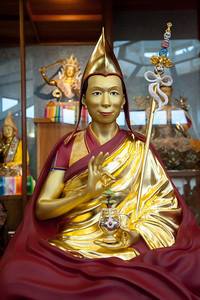
Statue of Kelsang Gyatso.
(It is uncommon to create statues of a living teacher in Tibetan Buddhism.)
With the controversies surrounding Dorje Shugden, Kelsang Gyatso’s views concerning how the tradition he received from his root teacher (Trijang Rinpoche) and other Gelug teachers should be practiced was seen by him as significantly different than the views of both the Dalai Lama, the highest Gelug Tulku, and the current Ganden Tripa, the head of the Gelug Tradition. This means he no longer recognised the authority of these teachers with respect to how the NKT was organised and what teachings they emphasized.[38]
The separation between Kelsang Gyatso and the wider Gelug tradition has also been underlined by a number of revisions made to later editions of his earlier publications. Kelsang Gyatso’s dedications to the long life of the Dalai Lama found in earlier editions of Meaningful to Behold are omitted from the fourth edition (1994) onwards. Also, Kelsang Gyatso made revisions to the list of Mahamudra lineage gurus in the second edition of Clear Light of Bliss published in 1992. In the first edition, Phabongkha Rinpoche was followed by Trijang Rinpoche and Ling Rinpoche, the ‘current holder of the throne of Ganden’. In the second edition, he omits Ling Rinpoche by replacing his name with that of ‘Dorjechang Kelsang Gyatso Rinpoche’ (i.e. Kelsang Gyatso). [39] Kelsang Gyatso said at an NKT Festival in 1995 that the Gelug tradition is in a state of “serious degeneration”.[40] Kelsang Gyatso has stated that the most effective way to progress spiritually through “following one tradition purely relying upon one Teacher, practising only his teachings, and following his Dharma Protector. If we mix traditions many obstacles arise and it takes a long time for us to attain realizations.”[41]
Whereas traditional ordination according to the Vinaya and Pratimoksha is given by a Sangha with a minimum of five fully ordained monks[42], the NKT ordination is given by Kelsang Gyatso, who ordains all monastics personally.[43] Waterhouse states: “NKT monks and nuns are simply described as ‘ordained’, and usually take the name ‘Kelsang’ from Kelsang Gyatso.” She also noted that the majority of monastics in NKT receive only the lower form of Getsul ordination (novices) and that there is an absence of an available equivalent of the Gelong (Skt. Bhikshu) full monastic ordination.[44] (For more see NKT Ordination.)
According to Bluck:
Apart from Geshe Kelsang, there are no ethnic Tibetans in the NKT, and no remaining links with the rest of Tibetan Buddhism. With no remaining Tibetan links, central control of teaching, little contact with other schools, an expanding programme of residential centres, widespread if selective publicity and overt proselytizing, the NKT as an organization is far removed from the mainstream of traditional Tibetan Buddhism.[44]
One of the effects of this rift is that in the New Kadampa Tradition, Kelsang Gyatso is viewed as the sole spiritual authority.[45] NKT members have described authority within the New Kadampa Tradition as follows: “There is only one Teacher in the NKT, Kelsang Gyatso; all other NKT Teachers are his emanations.”[46] A senior member and long-standing monk of the NKT explained: “The NKT hierarchy is Geshe Kelsang; and then there’s a successor, someone who will be the spiritual director of the NKT after Kelsang Gyatso passes away; and then there’s everybody else, all on the same level really.”[47]
While proclaiming Trijang Rinpoche (1901–1981) to be his “root guru” and keeping his main teacher, Geshe Lhundup Sopa (1923–2014), secret, Kelsang Gyatso made clear that he doesn’t accept the officially recognised incarnation of Trijang Rinpoche (Trijang Chocktrul Rinpoche). An Open Letter, dated 7 January 2017,[47a] from the Secretary of NKT Education Council, Steve Cowing, quotes Kelsang Gytaso from a meeting with the members of the NKT Education Council in 2000,
Trijang Tulku who was chosen by the Dalai Lama has no connection with me because I don’t believe that he is the reincarnation of my Root Guru Trijang Dorjechang.
According to the document he gave two reasons. “The first reason is that generally the Tibetan recognition of reincarnate Lamas, or Tulkus, is very unreliable and very uncertain.” While Kelsang Gyatso is apparently dismissive of Tibetan Lamas performing mos to divine whether monks have found the right candidate or not, the irony is that one of the leading people who would give such advice based on divination (Mo) was his own “Root Guru Trijang Dorjechang”.
The other reason is:
When I last met Trijang Dorjechang in India a short time before he passed away he told me twice that he was ready to go to Keajra [Kechara, the pure land of Vajrayogini], and I immediately understood that he was telling me that his reincarnation would not come.
He conlcudes, “Therefore, I have never believed that the boy chosen by this present Dalai Lama is the reincarnation of Trijang Dorjechang.”
What ever the reasons are for claiming that Trijang Tulku (the incarnation of his “root guru” ) is not authentic, it makes himself unaccountable to any higher Buddhist authority.
See also: NKT’s separation and isolation from mainstream Tibetan Buddhism
Further activities
Kelsang Gyatso continues to give teachings in Europe and North America.
According to NKT:
From his earliest days at Manjushri Centre, Geshe-la worked tirelessly to guide and inspire his students in every aspect of their spiritual life, and continues to do so for the benefit of his many disciples throughout the world. Geshe-la has given extensive commentaries on a great range of subjects from both Sutra and Tantra, but in addition to formal teachings Geshe-la has always been available for private consultations, helping students with their personal problems and being concerned with their health and welfare. Geshe-la has always encouraged his students to present Dharma in a way appropriate to their own culture and society without the need to adopt Tibetan culture and customs. Realizing that it would be difficult for many of his students to learn Tibetan, he taught himself English. Understanding the importance of presenting authentic commentaries in English and other languages, he devotes himself to writing and editing, as well as organizing the publication and translation of his books. All the royalties that he receives as author of these books he donates to Manjushri Centre.[5]
Temple project
Kelsang Gyatso has been the driving force behind the building of the NKT temples.[48] The first temple has been built in 1998 at Manjushri Centre, Cumbria. The second temple was opened in 2005, in Glen Spey, New York. In 2008 work was underway for a third temple near São Paulo, Brazil. These temples were built according to a design developed by Kelsang Gyatso. Further such temples were planned in 2008 at Tara Centre in Derby, England and in Melbourne, Australia as well as in Germany.
In 2015 the NKT official website does not give an exact number of existing NKT temples. However, the NKT website counts renovated buildings like that of Schloss Sommerswalde in Schwante, near Berlin, and other buildings in Toronto, Le Mans, Zurich, Texas, and Melbourne also as NKT temples.[48a]
“NKT members hope to build a Buddhist temple in every major town and city in the world. This project is known as the International Temples Project for World Peace.”[48]
Controversies
Although Kelsang Gyatso was described by some close Western followers as the “Third Buddha, because he has restored the essential purity of Buddha’s doctrine and shown how to practice it in extremely impure times”[49] [49a], and is described nowadays as “a fully accomplished meditation master and internationally renowned teacher of Buddhism”[50], he is seen as controversial as well.
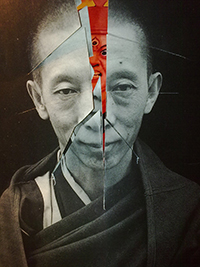
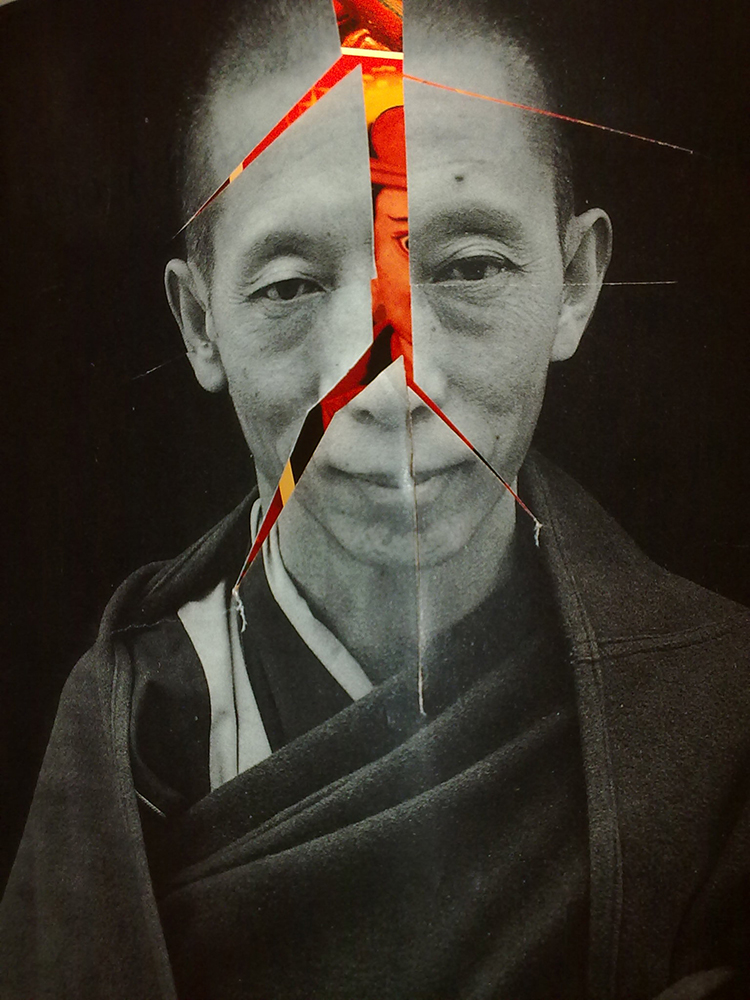
Geshe Kelsang Gyatso – through the eyes of an NKT Survivor.
The Sangha (community) of his order in Sera Je monastery issued a formal “Declaration of Expulsion” on August 22, 1996 expelling Kelsang Gyatso from his monastery.[51] Earlier Kelsang Gyatso had openly attacked the Dalai Lama in the West and in India over his stance on Dorje Shugden in a way that was unacceptable for Tibetans:
Tibetans cannot bear this outrageous behavior against the government and people of Tibet.[51a]
In June 1996 Kelsang Gyatso started to organize protests against the Dalai Lama in the UK calling him a “ruthless dictator” and “oppressor of religious freedom”[54], and in July 1996 Kelsang Gyatso published 2,000 copies of a polemical text entitled “A Sword That Cuts the Suffering Plaint of Tibetans-in Exile” circulating these amongst the Tibetan exile community, mainly in India. In this text Kelsang Gyatso condemned the Dalai Lama for spending his whole life collecting the wealth of simple Tibetan people, giving them no material help and doing nothing that is really helpful for Tibet:
He (the Dalai Lama) spent his whole life only collecting the wealth of simple Tibetan People. What material help has he provided to the Tibetan people? And regarding the issue of Tibet, what has he done that is really helpful?[51a]
Besides the questionable accuracy of this claim, as a matter of fact Kelsang Gyatso’s own family received help from an institution the Dalai Lama founded and from the Tibetan government.[51c]
Kelsang Gyatso also criticised the Dalai Lama for deceiving the Tibetan people, suppressing their democratic rights and freedom, and using his initiations, particularly the Kalachakra (for World Peace) to ‘control the public’ and ‘destroy his opponents’:
Using the teachings of the compassionate Buddha, especially the Kalachakra initiation, (the Dalai Lama) controls the public by using those events for the purpose of taking care of his own constituency and destroying his opponents. It is because of this that the present situation arose.[51a]
What became known as the “Sera Expulsion Letter” picked up these allegations and his monastic exiled community in India replied that the Dalai Lama is the main force “behind the democratization of the Tibetan community in exile”. The letter stressed how hard the Dalai Lama worked to make the Tibetan exile society more open, democratic and how “H.H. The Dalai Lama has repeatedly voiced his willingness to abdicate his present position and has transferred his power upon the forty-seven member elected representatives of the Tibetan people …”[51b]
As for his allegation that the Dalai Lama is using Kalachakra as a means of congregating masses, it is nothing but jealousy. If he were able to do it like the Dalai Lama, will he hesitate to do it? We advise him to accept the fact that he is an ordinary being and stand no chance whatsoever to challenge the Dalai Lama. He is not even a Geshe.[51b]
His monastery accused him further of having “usurped the FPMT [Manjushri] centre and made it his own NKT!”[51b]
Kelsang Gyatso’s attacks against the Dalai Lama were triggered by the Dalai Lama’s stance against Dorje Shugden practice – which the Dalai Lama strongly discourages. His anger against the Dalai Lama appears to have been present already in 1991.[62] In 1996 Kelsang Gyatso and his followers accused the Dalai Lama in public of putting a “ban” on the practice[52], and impinging on their religious freedom and of intolerance.[53] What started initially in London in early 1996 – with around 300 NKT protesters[51a] – became a world wide, well organized public protests and media campaign in Western countries.
The Anti-Dalai Lama protests were organised from 1996–98 and from 2008 onwards under different front groups – nowadays calling the Dalai Lama “false Dalai Lama”, “Worst Dictator of the Modern World”, “The Saffron-Robed Muslim” etc.
After NKT had received a lot of criticism by the international media during their first wave of protests (1996–98), Kelsang Gyatso stopped the campaign and wrote a number of open letters. In a letter to the Washington Times in 2002, he said: “However in October 1998 we decided to completely stop being involved in this Shugden issue because we realized that in reality this is a Tibetan political problem and not the problem of Buddhism in general or the NKT. We made our decision public at this time – everyone knows the NKT and myself completely stopped being involved in this Shugden issue at all levels. I can guarantee that the NKT and myself have never performed inappropriate actions and will never do so in the future, this is our determination.”[56]
Nevertheless, in 2008 Kelsang Gyatso ordered a new round of protests. But the international protest wave from 2008 onwards is more skillfully conducted via “human rights”, “religious freedom”, and “dialogue” rhetoric. Newsweek annotated in January 2015: “If the object is to puncture his [the Dalai Lama’s] image of universal popularity and hijack his news coverage, they are having considerable success.” Foreign Policy commented in March 2015:
And though the spirit’s followers in the Western world probably number only a few thousand, they’ve been surprisingly successful at generating attention for themselves and their campaign to discredit the Dalai Lama. Recently, Bloomberg, Reuters, and the Washington Post, among other outlets, have covered the Shugden followers’ protests, and in a measured tone — surprising for the absurdity of the Shugden followers’ claims.
Kelsang Gyatso stresses that he received the Dorje Shugden practice from his “root Guru” Trijang Rinpoche and instructed his students “to make the worship of the deity a central part of their practice”.[55] (For more see Dorje Shugden Controversy)
Some members of the FPMT who had stayed with Kelsang Gyatso at Manjushri Institute became quite critical about him:
These students often explain the emergence of the NKT in terms of the desire for power and prestige that, they believe, motivated Geshe Kelsang first to attempt to ‘seize control’ of the Institute and eventually to ‘steal’ it from its mother organisation. The origin of this drive for power is variously explained – as a result, for example, of the excessive devotion he received, upon arriving in England, from naive and undiscriminating Western practitioners; or as a product of his ‘Extreme envy’ of Lama Yeshe, who was formerly a junior student to him in Sera Je monastery but who had now become the key personality behind a growing worldwide network of centres. The emergence of the NKT is thus described as the growth of a ‘personality cult’, orchestrated by a ‘totally unscrupulous rogue geshe’ through the ‘cynical manipulation’ of students and the ‘transference of [their] loyalty and devotion’ via the practice of guru devotion.[57]
In the German Buddhist magazine Chökor, his behaviour was described as fanatical.[58] Tenzing Wangdak, a former Tibetan translator for an NKT center in Spain, Menorca, called Kelsang Gyatso a “Buddhist fundamentalist” … “How dare he say that he is following the pure lineage of Lama Tsongkhapa, while not allowing his own students to read Lama Tsongkapa’s books!” Wangdak quotes his own teacher, Gen Lobsang Gyatso, who said to him in 1986, “It is ironic that when you meet Kelsang Gyatso for the first time, he appears be a gentle, soft, and simple monk. He gives you the impression of someone who is on the verge of attaining Buddhahood in two or three days, but, he is rotten from inside in real life.”[58a] BBC stated: “Some Buddhists and non-Buddhists regard the New Kadampa Tradition as a cult, but the organisation has continued to grow.[59] Critics … accuse Kelsang of starting a breakaway movement and argue that the New Kadampa Tradition, as it is known today, is not part of the ancient Kadampa Tradition but a split from the Gelug school of Tibetan Buddhism.”[60]
On the other hand, there are also praises and acknowledgement of Kelsang Gyatso. The NKT praises him for being the one who “is primarily responsible for the worldwide revival of Kadampa Buddhism in our time” and that “In his teachings Geshe Kelsang emphasizes the importance of meditation and how to apply it in daily life, the need to be truly happy, and how to cultivate a good heart to help others — and he demonstrates these qualities perfectly in his own life. This remarkable teacher inspires so many people from so many different countries because he teaches from example. He is a humble Buddhist monk dedicated to helping people throughout the world find true happiness in their hearts.”[61]
One of the few Tibetans who praised Kelsang Gyatso after he started to attack the Dalai Lama openly was Tsem Tulku – a Tibetan Lama who practices Dorje Shugden.[62] In a letter Tsem Tulku wrote in 1994:
Learned spiritual teachers are becoming rare. Buddhist scholasticism in itself is not really beneficial, but combined with practice is something rare. You, I feel, are one of those rare combinations. … Very important to me is that the author has the lineage, states the lineage, follow a recognised text that has infallible authors themselves, and the translating authors have received the commentary themselves. Your works contain all of the above. I have confidence in your books. Because of the rarity of books, works, and sadhanas/commentaries of Je Pabongkhapa and Trijang Dorjechang translated in full, I rejoice from the depths of my heart in your works, your students assistance, and Tharpa Publications. Also the quality of the books and illustrations are excellent. I therefore sincerely request you and your students to please continue.[63]
Bibliography
- The Bodhisattva Vow: A Practical Guide to Helping Others, Tharpa Publications (Dec 1995)
- Buddhism in the Tibetan Tradition: A Guide, Routledge (1984)
- Clear Light of Bliss: Tantric Meditation Manual, Tharpa Publications; 2Rev Ed edition (Aug 1992)
- Eight Steps to Happiness: The Buddhist Way of Loving Kindness, Tharpa Publications (April 2000)
- Essence of Vajrayana: The Highest Yoga Tantra Practice of Heruka Body Mandala, Tharpa Publications (Jul 1997)
- Great Treasury of Merit: How to Rely Upon a Spiritual Guide, Tharpa Publications (Jun 1992)
- Guide to Dakini Land: The Highest Yoga Tantra Practice of Buddha Vajrayogini, Tharpa Publications; 2Rev Ed edition (Mar 1996)
- Guide to the Bodhisattva’s Way of Life: A Buddhist Poem for Today, a translation of Shantideva’s Bodhicharyavatara with Neil Elliott, Tharpa Publications (April 2003)
- Heart Jewel: The Essential Practices of Kadampa Buddhism, Tharpa Publications (April 1997)
- Heart of Wisdom: An Explanation of the Heart Sutra, Tharpa Publications (27 Aug 2001)
- How How to Solve Our Human Problems: The Four Noble Truths, Tharpa Publications (Jan 2005)
- Introduction to Buddhism: An Explanation of the Buddhist Way of Life, Tharpa Publications; 2Rev Ed edition (18 April 2001)
- Joyful Path of Good Fortune: The Complete Buddhist Path to Enlightenment, Tharpa Publications (Dec 1995)
- Living Meaningfully, Dying Joyfully: The Profound Practice of Transference of Consciousness, Tharpa Publications (Sep 1999)
- Mahamudra Tantra: An Introduction to Meditation on Tantra, Tharpa Publications (1 Sep 2005)
- Meaningful to Behold: The Bodhisattva’s Way of Life, Tharpa Publications; 4Rev Ed edition (Jan 1994)
- The New Meditation Handbook: Meditations to Make Our Life Happy and Meaningful, Tharpa Publications (1 Sep 2003)
- Modern Buddhism – The Path of Compassion and Wisdom, Tharpa Publications (2013)
- Ocean of Nectar: Wisdom and Compassion in Mahayana Buddhism, Tharpa Publications (Sep 1995) (see Review by John Powers)
- The Oral Instruction Of Mahamudra, Tharpa Publications (2014) – in Tibetan language only
- Tantric Grounds and Paths: How to Enter, Progress on and Complete the Vajrayana Path, Tharpa Publications (19 Oct 1994)
- Transform Your Life: A Blissful Journey, Tharpa Publications (Aug 2001)
- Understanding the Mind: The Nature and Power of the mind, Tharpa Publications; 3Rev Ed edition (1 Aug 2002)
- Universal Compassion: Inspiring Solutions for Difficult Times, Tharpa Publications; 4Rev Ed edition (1 Jul 2002)
Footnotes
- ^ David N. Kay: Tibetan and Zen Buddhism in Britain: Transplantation,
Development and Adaptation, London and New York, published by
RoutledgeCurzon, ISBN 0-415-29765-6, pages 88, 65,66; Inken Prohl, Free University of Berlin in a Book Review, [1]
[1a] Foreign Policy, Meet the Buddhists Who Hate the Dalai Lama More Than the Chinese Do, Isaac Stone Fish, March 13, 2015
[1aa] The Clear Light of Kelsang Gyatso, Carol McQuire (Oct. 2022) + Death Certificate
[1b] Open Letter from Sera monastery, signed by different Khangtsens, undated. To Tibetan Buddhists around the World …
[1c] From a reliable source who wishes not to be mentioned by name
[1d] ‘Heart Jewel’, Geshe Kelsang Gyatso, 2002, p. 11
[1e] Kelsang Gyatso being interviewed by his student Yvonne Nilles, http://groups.google.co.uk/group/alt.religion.buddhism.nkt/msg/4e76df4b3c6293ec
[1f] The World of Buddhism, Edited by Heinz Bechert and Richard Gombrich, Thames & Hudson, 2007, p. 246
[1g] Interviews in Cambridge, Meeting Children in London September 19th 2015. Offical Website His Holiness the Dalai Lama, http://dalailama.com/news/post/1317-interviews-in-cambridge-meeting-children-in-london, accessed: 2015/09/19
New web address: https://www.dalailama.com/news/2015/interviews-in-cambridge-meeting-children-in-london, accessed: 2017/04/30 - ^ see [2]; In June 2008 the New Kadampa Tradition sent the following letter to INFORM to let them know what Kelsang Gyatso’s understanding is with respect to the Geshe title controversy: Separate document regarding Geshe Kelsang’s personal situation.
- ^ Dorjee Shugden, The Spirit and the Controversy, [3]
[3a] Separate document regarding Geshe Kelsang’s personal situation. June 2008.
[3b] Information from a close student of Geshe Lhundup Sopa to Tenzin Peljor in 2007. Geshe Lhundup Sopa was a renowned and widely respected spiritual master of the Gelug tradition who died in 2014. Kelsang Gyatso does not mention to his followers who his teachers were. Instead he proclaims Trijang Rinpoche to be his “root guru”, indirectly suggesting that Trijang Rinpoche was also his main teacher. But though ordinary monks could visit Trijang Rinpoche, receive transmission or attend empowerments and in that way he could become their root guru, Trijang Rinpoche taught monastic studies at Ganden Shartse not at Sera Je, so he cannot have been Kelsang Gyatso’s main monastic teacher. In the Gelug school a “root guru” (rtsa ba’i bla ma) is commonly understood to be any tantric master from whom one received 1) a tantric initiation of a given deity, 2) the oral transmission of the Sadhana of that deity, and 3) the commentary to the practice of this tantric deity. However, a root guru can also be the one who benefits the student the most on the spiritual path (this is suggested by Pabongkha Rinpoche and other Buddhist teachers). One can also have many “root gurus”. There are different explanations. The root guru of Je Tsongkhapa was Manjushri.
[3c] “Like a Waking Dream. The Autobiography of Geshe Lhundup Sopa”, Wisdom Pub, 2012, p. 271 - ^ Kay 2004 : 56
- ^ a b c d Modern Day Kadampas - published by NKT, [4]
- ^ Kay 2004 : 37
[6a] Kay 2004: 56
[6b] For a detailled account see Kay 2004: 61–69
[6c] Kay 2004: 64
[6d] Information from a Lharampa Geshe at Drepung monastery, India, Mundgod, Gomang College to Tenzin Peljor in 2015.
[6e] Kay 2004: 77
[6f] Waterhouse, Helen (1997). Buddhism in Bath: Adaptation and Authority. University of Leeds, Department of Theology and Religious Studies. p. 143.
[6g] The Eternal Legacy: An Introduction to the Canonical Literature of Buddhism, Tharpa Publications (1985) by Sangharakshita, ISBN 0-948006-02-1. (PDF) - ^ NKT sources: [5]
- ^ retrieved from http://kadampa.org/centers/, 29.01.2015.
In 2008, when the body of this article was written, there were according to the Manjushri Kadampa Meditation Centre “almost 900 meditation centres in over 40 countries.”[6] After public criticism on Wikipedia’s NKT talk page about the manipulative nature of this number of 900 NKT centres – rented rooms in public community centres, in libraries or the private rooms of NKT followers are also counted as “meditation centres” – NKT editors added to Wikipedia “They divide into about 200 residential centres and 700 groups at local places, such as rented rooms in libraries, local community centres, and members’ apartments.” There is no reliable source that states the exact numbers and nature of NKT centres. NKT leadership in general tends toward to exaggerate numbers. - ^ Official NKT Website, [7]
- ^ Waterhouse 1997 : 151
- ^ Kay 2004 : 75
- ^ Kelsang 2001: 79-80
- ^ Kelsang Gyatso: Joyful Path of Good Fortune, page 106, ISBN 0948006463
- ^ Kelsang 1991b: 17
- ^ Kelsang 1992: 31
- ^ Kelsang Gyatso, Great Treasury of Merit, page 41, ISBN 8120818695
- ^ Bluck 2006 : 143
- ^ Kelsang Gyatso: Understanding the Mind, page 75, ISBN 8120818911
- ^ Kay 2004 : 58
- ^ Kelsang Gyatso 1982: 144
- ^ Kelsang Gyatso 1993a: 78
- ^ Kelsang Gyatso 1982: 180
- ^ Kelsang Gyatso 1982, 2nd edn: 190
- ^ Kelsang Gyatso 1991b: 17, see Kay 2004: 92
- ^ Kelsang Gyatso 1992: 102
- ^ Kay 2004 : 91,92
- ^ Bluck 2006 : 143
- ^ Kelsang 2001: 211, 190
- ^ Bluck 2006: 144
- ^ a b c Dorje Shugden, explained by Geshe Kelsang Gytaso, Official NKT Website, [8]
[30a] The translation is made by Shugden followers. The usage of English terms which should represent the meaning of the Tibetan is often not very precise and suggestes an ideological bias.
[30b] Kay 2004: 44–52 - ^ BBC, [9] (PDF)
- ^ A Brief History Of Opposition To Shugden by The Dolgyal Research Committee, TGIE, [10](PDF)
- ^ A Spirit of the XVII Secolo, Raimondo Bultrini, Dzogchen Community published in Mirror, January 2006
- ^ “Smear campaign sparks safety fears over Dalai Lama’s UK visit” by Madeleine Bunting, Religious Affairs Editor, The Guardian - London, July 6, 1996
- ^ An Interview With Geshe Kelsang Gyatso: Geshe Kelsang Gyatso discusses Dorje Shugden as a benevolent protector god. Spring 1998. Tricycle
- ^ Open letter from Geshe Kelsang Gyatso to Wesley Pruden, editor in chief, The Washington Times, Press Statement — November 25, 2002, [11]
[36a] Oxford Advanced Learner’s Dictionary, Oxford University Press, 2000, digital version.
[36b] Lexikon Apple, Version 2.2.1. (156), Plug-in Oxford Dictionary English
[36c] Deshung Rinpoche,1983, “BUDDHISM WITHOUT SECTARIANISM”, Translated by Jared Rhoton, http://quietmountain.org/links/teachings/nonsect.htm; see also: David P. Jackson (2003). A Saint in Seattle: The Life of the Tibetan Mystic Dezhung Rinpoche, Wisdom Publication
[36d] In Tsongkhapa,The Great Treatise on the Stages of the Path to Enlightenment, Lam Rim Chen Mo, Vol I, Trans.The Lamrim Chenmo Translation Committee, Snow Lion Publications, 2000; p. 75ff, Tsongkhapa states this about the three defining characteristics:
It is stated in Candrakirti’s commentary that if you, the listener, do not have all these defining characteristics of a suitable recipient of the teachings, then the influence of your own faults will cause even an extremely pure teacher who instructs you in the teachings to appear to have faults. Furthermore, you will consider the faults of the one who explains the teachings to be good qualities. Therefore, although you might find a teacher who has all the defining characteristics, it may be difficult to recognize their presence.
“Thus, it is necessary for the disciple to have these three characteristics in their entirety in order to recognize that the teacher has all the defining characteristics and in order then to rely on that teacher.”
[36e] Tsongkhapa,The Great Treatise on the Stages of the Path to Enlightenment, Lam Rim Chen Mo, Vol I, Trans. The Lamrim Chenmo Translation Committee, Snow Lion Publications, 2000; p. 75ff
[36f] Kelsang Gyatso, Understanding the Mind, Tharpa Publications; 1993; p. 167
[36g] Kelsang Gyatso, Understanding the Mind, Tharpa Publications, 1993; p. 166
[36h] Kelsang, Clear Light of Bliss, Tharpa Publications, 1982; p. 154
- ^ von Brück, Michael (1999). “Religion und Politik im Tibetischen Buddhismus”, page 159. München: Kösel Verlag. ISBN 3-466-20445-3
- ^ Kay page 59
- ^ David N. Kay: Tibetan and Zen Buddhism in Britain: Transplantation, Development and Adaptation, London and New York, page 89
- ^ David N. Kay: Tibetan and Zen Buddhism in Britain page 88
- ^ Great Treasury of Merit: How to Rely Upon a Spiritual Guide, Geshe Kelsang Gyatso, Tharpa Publications (Jun 1992), page 31).
- ^ Buddhist Ethics (Treasury of Knowledge) by Jamgon Kongtrul Lodro Taye, ISBN 1-55939-191-X, p. 90
- ^ a b British Buddhism Teachings, Practice and Development by Bluck, Robert, ISBN 0-415-39515-1, Publisher: RoutledgeCurzon
- ^ Waterhouse 1997, 175; see also Kay page 233
- ^ Kay page 84-86
- ^ Gen Kelsang Thubten, a former designed successor of Geshe Kelsang; NKT Magazine Full Moon, spring 1994; see also Kay page 95
- ^ Kay page 84
[47a] Open Letter, 7th January 2017, From: Secretary of NKT Education Council, Steve Cowing - ^ a b BBC (bbc.co.uk), The New Kadampa Tradition (PDF)
[48a] retrieved from http://kadampa.org/en/temples, 29.01.2015 - ^ NKT magazine Full Moon, Spring 1995, Gen Kelsang Thubten, successor at that time of Geshe Kelsang; Madeleine Bunting, The Guardian, 1996, [12]
[49a] Kelsang Gyatso replied with respect to the Third Buddha claim in the BBC documentary An Unholy Row: “People who are thinking Geshe Kelsang is the Third Buddha is not bad. Maybe they think like this because their pure mind. Because they are happy with me and there is some benefit from spiritual, you know. So maybe they think ‘oh maybe he Buddha’. That is nothing wrong [laughs].” This BBC documentary includes also an analysis by Stephen Batchelor about the contextual setting of the NKT. - ^ Official NKT website, [13]
- ^ von Brück, Michael (1999). Religion und Politik im Tibetischen Buddhismus, page 159. München: Kösel Verlag. ISBN 3-466-20445-3 and Donald S. Lopez, Jr., “Prisoners of Shangri-La”, ISBN 0-226-49310-5, University of Chicago Press, page 195
[51a] “Earth Shaking Thunder of the True Word: A Refutation of Attacks on the Advice of HH the Dalai Lama Regarding the Propitiation of Guardian Deities.” by Tenpai Gyaltsan Dhongthog, Sapan Institute, 1996, p.13ff & p. 33. (see full document: The Earth Shaking Thunder of True Word)
[51b] Open Letter from Sera monastery, signed by different Khangtsens, undated. To Tibetan Buddhists around the World …
[51c] see the documents in: Kelsang Gyatso’s Tibetan Relations - ^ Bunting, The Guardian, 1996, on July 6; Lopez 1998:193
- ^ Lopez 1998:193
- ^ Bunting, The Guardian, 1996, on July 6
- ^ Lopez 1998:193
- ^ Press Statement, Nov. 25, 2002, Open Letter by Geshe Kelsang to Wesley Pruden, Editor in Chief, The Washington Times, [14]
- ^ Kay page 83
- ^ German Buddhist magazine “Chökor”, No. 25, 1998, page 50
[58a] A Tibetan Translator’s Testimony by Tenzing Wangdak, 20th January 2015 - ^ BBC at [15] (PDF)
- ^ BBC at [16] (PDF)
- ^ Official NKT website, [17]
- ^ Tsem Tulku official blog: I can speak up now about Shugden, Jan 27, 2015, and see posts he wrote subsequently
- ^ A letter to Geshe Kelsang Gyatso, Full Moon Magazine 1994, Tsem Tulku Rinpoche, Tsem Labrang, Ganden Shartse College, Mundgod, India. [18]
Additional Footnote
For Geshe Kelsang Gyatso’s expulsion from Sera Je Monastery see:
References
- Belither, James (year unknown). Modern Day Kadampas: The History and Development of the New Kadampa Tradition. New Kadampa Tradition. (PDF)
- Bluck, Robert (2006). British Buddhism: Teachings, Practice and Development. RoutledgeCurzon, ISBN 0-415-39515-1
- Brown, Andrew (1996). Battle of the Buddhists. The Independent, London, 15 July 1996. (PDF)
- Bunting, Madeleine (1996). Shadow boxing on the path to Nirvana, The Guardian – London, (PDF)
- Cozort, Daniel (2003). The Making of Western Lama in “Buddhism in the Modern World”, ISBN 0-19-514698-0
- Kay, David N. (1997). The New Kadampa Tradition and the Continuity of Tibetan Buddhism in Transition, Journal of Contemporary Religion 12(3) (October 1997), 277-293 (PDF)
- Kay, David N. (2004). Tibetan and Zen Buddhism in Britain: Transplantation, Development and Adaptation - The New Kadampa Tradition (NKT), and the Order of Buddhist Contemplatives (OBC), London and New York, ISBN 0-415-29765-6 (PDF)
- Gyatso, Kelsang (1982), Clear Light of Bliss, London: Wisdom Publications (2nd edn, London: Tharpa Publications, 1992)
- Gyatso, Kelsang (1992), Great Treasury of Merit, London, Tharpa Publications
- Gyatso, Kelsang (2005), Guide to Dakini Land, (2005 reprint), London: Tharpa Publications, ISBN: 978-0948006-40-1
- Gyatso, Kelsang (2002), Heart Jewel: The Essential Practices of Kadampa Buddhism, London: Tharpa Publications.
- Kelsang Gyatso (2005): Joyful Path of Good Fortune, London: Tharpa Publications, ISBN 0948006463
- Lopez Jr, Donald S. (1998). Prisoners of Shangri-La: Tibetan Buddhism and the West, University of Chicago Press, ISBN 0226493105
- Prohl, Inken. Book Review of Kay (2004): “Tibetan and Zen Buddhism in Britain …”
- Waterhouse, Helen (1997). Buddhism in Bath: Authority and Adaptation, Leeds: Community Religions Project Monograph Series, University of Leeds, ISBN 1-871363-05.
External links
New Kadampa Tradition
- New Kadampa Tradition official website
- New Kadampa Truth
- Tharpa Publications – The publisher of Geshe Kelsang Gyatso’s books
- Kelsang Gyatso’s Meditate in London site
Criticism related to Kelsang Gyatso
- The One Pure Dharma: The New Kadampa Tradition is controversial—and growing. Why? By Judith Hertog (Tricycle)
- BBC: An Unholy Row British-Asian current affairs series
- The Independent, London: Battle of the Buddhists by Andrew Brown (PDF)
- The Guardian - London: Shadow boxing on the path to Nirvana by Madeleine Bunting (PDF)
- CESNUR: New Kadampa Tradition (NKT) Controversy
- Kelsang Gyatso’s Teachings for Westerners – ‘From Dharma into Dogma?’ by Carol McQuire
- The Monk Who Had No Confidence: ‘Venerable Geshe Kelsang Gyatso Rinpoche’ by Carol McQuire
- Open Letter to Followers of the New Kadampa Tradition by Gavin Kilty
- The Clear Light of Kelsang Gyatso by Carol McQuire
- Kelsang Gyatso obituary – The Guardian
- Geshe Kelsang Gyatso, Founder of the Controversial New Kadampa Tradition, Has Died – Tricycle
- Geshe Kelsang Gyatso, Founder of the New Kadampa Tradition, Has Died Aged 91 – Buddhist Door / Justin Whitaker
- Declaration of Expulsion of Kelsang Gyatso from Sera Je Monastery – Shambhala Publications (origin letter)